npmの@antvパッケージがサプライチェーン攻撃で侵害される
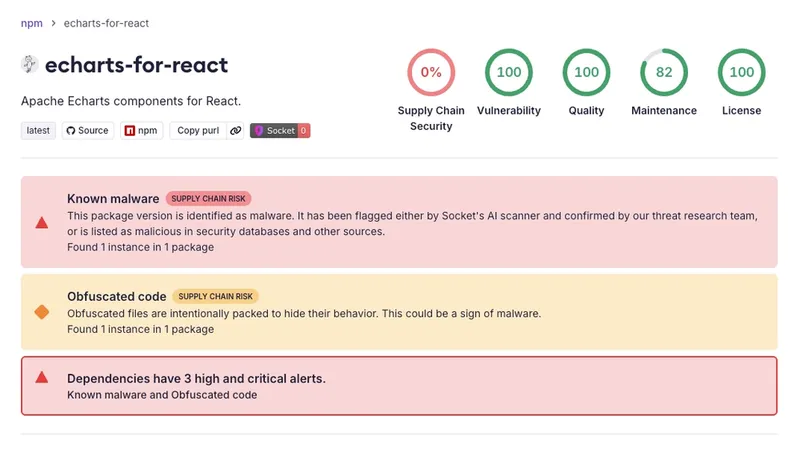 @antvパッケージへのnp
npmのエコシステムにおいて、@antvパッケージ群を対象とした活発なサプライチェーン攻撃が検出されました。
この攻撃は、侵害されたメンテナーアカウントを利用したMini Shai-Hulud型の悪意あるパッケージ公開パターンに一致しています。
悪意あるペイロードは、インストール時に実行され、GitHubトークンやAWS認証情報などの機密情報を収集します。
収集されたデータは暗号化され、HTTPSエンドポイントやGitHubを介して外部へ流出します。
さらに、このペイロードは盗まれたnpm認証情報を用いて他のパッケージを改変・再公開する自己増殖的な動作も持ち合わせています。
npmエコシステムで大規模なサプライチェーン攻撃が発生していることが明らかになりました。データ可視化ライブラリとして広く利用されている@antv関連のパッケージ群が標的となっており、悪意のあるコードが組み込まれたパッケージが公開されています。セキュリティベンダーのSocket社が調査を進め、この脅威の全容解明と対策を呼びかけています。
大規模な@antvパッケージの汚染状況
今回の攻撃は、npmのメンテナーアカウントが侵害されたことに端を発しています。特に、Apache EChartsのReactラッパーであるecharts-for-reactなど、週に110万回ものダウンロードがある人気パッケージが影響を受けています。Socket社の調査では、@antv/g2や@antv/g6など、データ可視化やグラフ描画に不可欠な多数のパッケージが汚染されていることが確認されました。この影響範囲の広さは、データ分析やフロントエンド開発を行う多くの組織にとって重大なリスクとなります。
マルウェアの動作と情報窃取の仕組み
検出された悪意のあるペイロードは、「Mini Shai-Hulud」と呼ばれるサプライチェーンマルウェアのパターンと一致しています。このコードは、パッケージのインストール時に実行されるよう仕込まれており、開発環境やCI/CD環境を狙っています。具体的には、GitHubトークン、AWS認証情報、データベース接続文字列といった機密性の高い開発者秘密情報を窃取しようとします。窃取されたデータは、AES-256-GCMで暗号化され、外部の指定されたHTTPSエンドポイントへ送信されます。
GitHubを悪用したデータ流出経路
さらに、このマルウェアは直接的なHTTPS通信だけでなく、GitHubを悪用したデータ流出経路も持っていることが判明しました。被害者のGitHubアカウント内にリポジトリを作成し、盗み出したデータをコミットする仕組みです。これは、信頼されている開発プラットフォームを攻撃のインフラとして利用する、Mini Shai-Huludの典型的な手口です。この二重の流出経路により、検知と対策がより複雑化しています。
結論
今回のnpmサプライチェーン攻撃は、広く使われるライブラリを介して組織の機密情報にアクセスしようとする、極めて深刻な事例です。開発者は、依存関係のセキュリティを定期的に監査し、特に外部から取得するパッケージの信頼性を厳重に確認することが求められます。Socket社は引き続き調査を継続するとしています。
原文の冒頭を表示(英語・3段落のみ)
Secure your dependencies with usSocket proactively blocks malicious open source packages in your code.InstallSocket’s Threat Research team is investigating an active npm supply chain attack involving compromised packages in the @antv ecosystem.The attack affects packages tied to the npm maintainer account atool, including echarts-for-react, a widely used React wrapper for Apache ECharts with roughly 1.1 million weekly downloads. Socket quickly detected the malicious publish wave and classified the affected versions as known malware.Socket’s internal review identified hundreds of unique packages. The pattern matches Mini Shai-Hulud, a high-volume npm compromise pattern involving coordinated malicious publishes across packages tied to a compromised maintainer account.The affected package set includes widely used @antv packages such as @antv/g2, @antv/g6, @antv/x6, @antv/l7, @antv/s2, @antv/f2, @antv/g, @antv/g2plot, @antv/graphin, and @antv/data-set, along with related packages outside the @antv namespace, including echarts-for-react, timeago.js, size-sensor, canvas-nest.js, and others.The potential blast radius is significant because the affected publishing account is connected to widely used packages across data visualization, graphing, mapping, charting, and React component ecosystems. Even if only a subset of those packages received malicious updates, the popularity of the package ecosystem creates meaningful downstream exposure for organizations that automatically pull new dependency versions.That scale makes this one of the larger npm supply chain incidents Socket has investigated recently.This is a developing story. Socket is continuing to investigate the full scope of the compromise and will update this post as additional affected packages, versions, and payload details are confirmed.Technical Analysis: Malicious Payload#Our review of compromised @antv artifacts identified an install-time payload consistent with the Mini Shai-Hulud supply-chain malware family. A root-level index.js payload modifies package.json to execute it during installation:"preinstall":"bun run index.js"The injected index.js file is heavily obfuscated. It uses a large string-array lookup table, runtime string decoding, and a custom decryptor exposed through globalThis as fc2edea72. Decoded strings reveal the primary exfiltration endpoint, GitHub API usage, npm registry API usage, lock-file paths, and internal execution markers. This obfuscation is designed to hide sensitive strings from simple static inspection and is consistent with prior Mini Shai-Hulud variants observed across npm supply-chain compromises.The payload establishes a hardcoded HTTPS exfiltration path: https://t[.]m-kosche[.]com:443/api/public/otel/v1/traces.Collected data is serialized, compressed with gzip, encrypted with AES-256-GCM, and the AES key is wrapped using RSA-OAEP with SHA-256 before transmission. This prevents defenders from easily recovering stolen plaintext from network telemetry.The payload targets developer and CI/CD environments. It searches for GitHub tokens, npm tokens, AWS credentials, Kubernetes service-account material, Vault tokens, SSH/private keys, Docker authentication files, database connection strings, and other high-value development secrets. It also contains logic for common CI/CD platforms, including GitHub Actions, GitLab CI, Travis CI, CircleCI, Jenkins, Azure DevOps, AWS CodeBuild, Buildkite, AppVeyor, Bitbucket Pipelines, Drone, Semaphore, TeamCity, Bamboo, Bitrise, Vercel, Netlify, and Cloudflare Pages.GitHub Fallback ExfiltrationIn addition to the direct HTTPS endpoint, the payload includes a GitHub-based fallback exfiltration mechanism. If it obtains a usable GitHub token, it can create a repository under the victim’s account and commit stolen data into files under a results/ directory, using paths that follow this pattern:results/results-<timestamp>-<counter>.jsonThis behavior aligns with the broader Mini Shai-Hulud pattern of abusing trusted developer platforms as exfiltration and staging infrastructure. Socket previously documented GitHub repository creation in Mini Shai-Hulud-linked campaigns, including repository names following a <word>-<word>-<3 digits> pattern and repository descriptions used as campaign markers.Public GitHub search results for the reversed phrase niaga og ew ereh :duluh-iahs currently show roughly 1.9k repositories using the marker niagA oG eW ereH :duluH-iahS, which reverses to Shai-Hulud: Here We Go Again. The visible repositories use Dune-themed names such as sayyadina-stillsuit-852, atreides-ornithopter-112, harkonnen-phibian-552, fremen-fedaykin-225, and kanly-lasgun-874.One observed repository, Zaynex/sayyadina-stillsuit-852, contains a results directory and a README containing the same reversed marker. This matches the payload’s GitHub repository exfiltration logic and suggests the GitHub fallback path is operational.GitHub search reveals a rapidly updating cluster of threat actor-created repositories using a reversed Shai-Hulud campaign marker and Dune-themed naming, supporting the assessment that the malware’s GitHub fallback exfiltration path is active at scale.npm Propagation LogicThe payload also contains npm registry abuse logic. It can validate npm tokens through npm registry APIs, enumerate packages maintainable by the token owner, download package tarballs, inject the malicious payload, add a preinstall hook, bump package versions, and republish modified packages under the compromised maintainer’s identity.The injected package modification follows this general pattern:{
"scripts": {
"preinstall":"bun run index.js"
※ 著作権に配慮し、引用は冒頭3段落までです。続きは元記事をご覧ください。