新しい発明はどれくらいかかるのか?技術革新の待機期間をAIで分析
 発明実現までの待機期間
科学史における事例から、技術的な前駆要素が存在しても、発明が実体化するまでに長い期間が空くことが指摘されている。
本記事では、そのギャップの性質を明らかにするため、AI(Claude)を用いて190の主要な発明について、最も早く実現可能だった時期を推定した。
分析では、実現可能性や経済的有用性ではなく、「当時の知識と技術で、熟練チームが動作する試作品を構築できるか」という基準を採用した。
このシミュレーションを通じて、技術的可能性から実際の製品化に至るまでを規定する要因、例えば知識の交配や科学的枠組みの存在といった要素の重要性が示唆されている。
技術的な実現可能性と、実際に社会に普及するまでの間に、なぜこれほどの時間差が生じるのでしょうか。歴史的な発明の事例を分析した結果、そのギャップを埋める要因は単なる技術力だけではないことが示唆されています。本記事では、AIを活用して190の主要な発明について「いつ実現可能だったか」をシミュレーションした研究結果を解説します。
技術的実現可能性の定義と課題
研究では、発明が「いつ実現可能だったか」を判断するため、特定の基準を設定しました。単に「動くサンプルを作れるか」という技術的な可能性に焦点を当て、実用性や経済的価値は考慮していません。例えば、電球はエジソンが実用化するまで何十年も前に試作されていましたが、この分析では「動くものが作れるか」という視点で評価しています。
このシミュレーションでは、時代に合った十分な設備と熟練したチームが、5年以内に発明を完成させられるかを仮想的に検証しました。ただし、新しい科学的原理の発見や、根本的な知識の飛躍的な進歩は認めないという制約を設けています。
発明実現までの時間差の要因
歴史的な事例、例えばレーザーの発明が、その前提技術(マザーや誘導放出)が何十年も存在していたにもかかわらず、なぜすぐに実現しなかったのかという問いが立てられています。その背景には、技術的な可能性以上に、「知識の交差点」が重要であるという指摘があります。
具体的には、当時の研究者やエンジニアが、異なる分野の知識や技術を組み合わせるという発想に至るまでに、十分な交流や認識が不足していたことが、実現までの遅延の大きな要因と見られています。つまり、技術の「可能性」と「組み合わせる知恵」の間に大きなギャップがあるのです。
AIによる発明実現時期の予測
この研究では、AI(Claude Opus 4.7)に190の主要な発明リストを渡し、それぞれの発明が最も早く実現可能だった時期を予測させました。AIは、実現に必要な前提技術や科学的知識を特定し、実現可能な最も早い日付と、複数のチームが収束するであろう標準的な日付の範囲を提示しています。
この分析は、技術の進歩が単なる技術力の積み重ねではなく、知識の「クロス・ポリネーション(相互作用)」や、社会的な要因が大きく影響していることを示唆しています。
結論: 技術進歩の真のドライバー
発明が技術的に可能になった時点から社会に現れるまでの期間は、単なる時間的な遅延ではなく、知識の統合や社会的な認識の成熟度を反映しています。技術進歩の真のドライバーは、技術的な「可能性」だけでなく、異分野間の知識を融合させる「知恵」や「環境」にあると言えるでしょう。
原文の冒頭を表示(英語・3段落のみ)
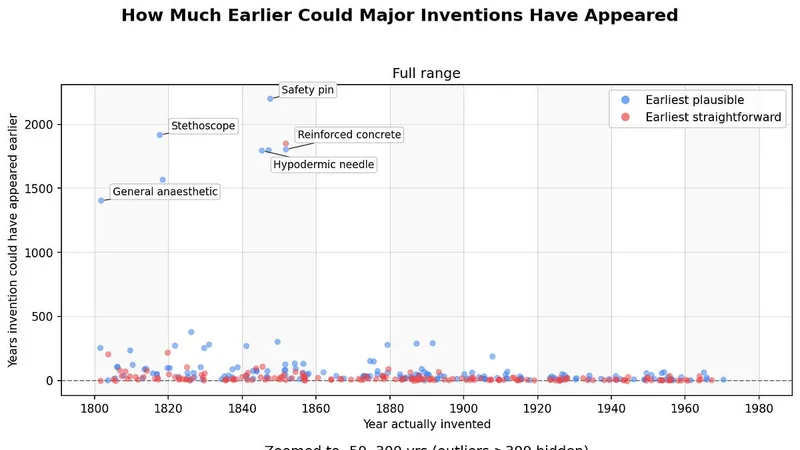
In her book on the history of the laser, historian Joan Bromberg notes that the technological and scientific predecessors of the maser (which itself preceded the laser - two critical technologies whose developmental histories I sketched in this piece two months ago) were in place for decades before physicist Charles Townes had the insight to combine them:Stimulated emission had been known to physicists for over 30 years, and “regenerative” oscillators, that is, oscillators with feedback, were well known to engineers. Why, then, was Towne’s insight so novel? The answer appears to be that in 1951, physicists and engineers in the United States were not yet sufficiently acquainted with each other’s territory to find it natural to put the two ideas together.This sort of decades-long wait between when a technology first becomes possible, and when it actually appears, seems common, or at least seems like it might be common. I’ve previously written about why it took so long for wind power to be widely deployed after it became technologically possible, and people often idly speculate whether inventors in the Roman Empire could have built a steam engine, or why we waited so long to put wheels on luggage.Knowing how long this gap between when an invention becomes possible, and when it actually appears, is useful, because it tells us something about the nature of technology and technological progress. What factors govern whether some new technology appears? How much does mere technical possibility matter, and how much do things like cross-pollination of knowledge, economic feasibility, and political factors contribute? Knowing more about how long it takes for an invention to appear once it becomes technically possible can help us answer these sorts of questions.I wanted a better sense of how long it takes for some technology to appear once its necessary predecessors are in place. So I used AI to try and find out.To do this, I used a list of 190 major inventions that I’ve used for previous analyses of technology. For each invention, I asked Claude Opus 4.7 how much earlier it could have been invented.This required pinning down what exactly I mean by “could have been invented.” For one, it’s often possible to build a working example of some technology long before it’s capable of solving a real problem. Working incandescent light bulbs were built decades before Edison, but they weren’t useful for providing indoor illumination until Edison developed one that lasted for many hours without blackening or burning out. For another, it’s often possible to build something before the problem that it solves has been articulated. Surgical masks — a cloth covering over the face — could have been invented thousands of years ago, but inventing them only makes sense once the germ theory of disease has been articulated.Nonetheless, I decided to use “could a working example of this technology be built” as my meaning, ignoring whether that technology would be practical or economically useful. In part I chose this criterion to follow the contours of the inventions list, which for the most part is when things were first invented, not when they first improved to the point of becoming practical for regular use. For instance, the list includes the ballpoint pen as being invented in 1888 by John Loud, even though practical ballpoint pens didn’t appear until the 1930s. I also chose this criterion because pinning down technical possibility seemed difficult enough without also having to consider questions like “would someone in this time period be willing to pay for a technology that worked roughly this well?”, which seems like a much harder question.I specified “could a working example of this technology be built” as follows: I asked Claude to assume an inventor working in a well-equipped, era-appropriate workshop with a team of highly skilled engineers and craftsmen. Could they, using knowledge and technology available at the time, build a working example of the technology in five years?I allowed the hypothetical team to build one required precursor technology, if that technology was simple enough that the team could plausibly build it along with the invention in question. For instance, Edison’s light bulb was predicated on the demonstration of Sprengel’s 1865 mercury vacuum pump, using those insights to achieve vacuum high enough that the filament wouldn’t burn out quickly. However, a Sprengel mercury pump is not amazingly complicated — it works by dropping mercury through a glass tube, forcing air out along with it — and it’s plausible that a team working to build a better incandescent lamp could have invented it as a collateral innovation as part of their improvement efforts. (Edison, after all, had to invent lots of other technology — generators, distribution systems, etc. — along with his bulb to make it practical.)I also allowed the fictional team to generate new knowledge through iteration and engineering-style experimentation, but I did not allow them to discover new scientific frameworks or make novel key empirical observations guided purely by scientific curiosity. So a team trying to build an electric motor in the early 19th century in this simulation could not just summon up Oersted’s critical observation that electric current creates a magnetic field, and a team trying to invent the transistor in the early 20th century would not have access to the band theory of quantum mechanics.You can read the entire prompt I used here.For the output, I had Claude list a range encompassing two dates. The first is the earliest plausible date for when the inventor’s team could have succeeded with some charitable assumptions and a bit of luck. The second is the straightforward date, when multiple independent teams would be likely to converge on a working model of the invention. Along with the date range, I had Claude list the necessary prerequisite technologies and scientific knowledge, and give a short explanation of its reasoning. An example of the output from Claude for an invention is below:Claude gave ranges for 166 of the 190 inventions. The other 24 it flagged, mostly either because it was a scientific discovery rather than an invention (like X-rays) or because its real-life invention was a serendipitous accident that couldn’t be expected to be recreated earlier (like Perkin’s invention of mauve dye). You can read the full document with all Claude’s answers here.One issue I noticed reading through the answers is that I didn’t do quite enough to pin down cases like the surgical mask, which are gated almost entirely by conceptions of the problem. There’re a few other items like this, notably Morse Code and Braille, and while Claude did a reasonable job of handling them (it gave answers for Morse Code and the surgical mask which assumed that they needed to wait until the problem was articulated, and flagged Braille) but if I was re-running this simulation I would give more specific instructions for handling cases like these.Based on previous work I’ve done using AI to answer questions about the nature of technology and science, I expected the answers I got to be reasonably good, though not perfect. But while AI hallucinations have become much less of a problem, the ability of an AI model to provide quality output on tasks like this is definitely still a moving target. So I took several steps to try and verify Claude’s answers.First, I did spot checks for various specific, verifiable claims that Claude made regarding various required predecessors. In the arc lamp example above, for instance, I checked whether Galvani published research on electric current in 1791 (he did). And for 20 of the inventions, I fed the entire output back to Claude, and asked it to pair each verifiable claim with a reliable source, and flag any cases where the claims were incorrect or a reliable source couldn’t be found. (I then checked these sources for accuracy.) This yielded an accuracy rating of around 97% — only a tiny number of verifiable claims were inaccurate, and the inaccuracies were relatively minor (such as a claim that something was common by the 1850s when it should have been the 1860s.)Screenshot from a verification run.Checking people and dates is one thing, but this doesn’t tell us the most important part: whether Claude correctly identifies the actual binding constraints for creating a given invention. To try and verify this, I read through Claude’s analysis of several inventions that I know well enough myself.Here’s the first sample answer, which Claude produced for the Fleming valve:The Fleming valve is essentially an Edison-effect lamp with the cold electrode brought out as a usable anode and the device used as a rectifier. All physical prerequisites — evacuated bulb, carbon filament, sealed lead-throughs, battery, galvanometer — were in place by 1880. The binding item is the Edison effect itself (1883). If we treat thermionic emission as off-limits before 1883 (it required Edison to notice the unilateral current in his lamps, not something a rectifier-builder would set up to look for), the earliest plausible date is essentially 1883–1890: a motivated team aware of Edison’s observation could have made the small inferential leap to “this rectifies AC” almost immediately, especially once Hertz (1887) created a clear use case for a sensitive RF detector. Earliest straightforward sits in the late 1890s, after Hertzian-wave work motivated multiple labs (Marconi, Lodge, Braun, Fleming) to seek better detectors than the coherer; Fleming himself was investigating the effect from the early 1890s and could have arrived at the diode concept several years before his 1904 patent. The historical 1904 date reflects how long it took to connect Edison’s curiosity finding to the practical problem of wireless detection.Here’s the second, the Wright brothers’ airplane:The Wright Flyer is a clean case where the binding constraint is the lightweight internal combustion engine. Cayley had laid out the basic principles of fixed-wing flight by 1810, gliders were practical from mid-19th century, and Wenham’s wind tunnel (1871) plus Lilienthal’s glider work (1890s) gave aerodynamic data. The three-axis control concept is team-discoverable through glider iteration — it’s an engineering insight, not a scientific discovery. The hard prerequisite is a roughly 10-hp engine weighing under ~200 lb, which only becomes feasible after the Otto cycle (1876) and Daimler/Benz refinements of the mid-1880s; steam plants of earlier eras were too heavy. With a Daimler-class engine available by ~1885 and Lilienthal-style glider knowledge accumulating, a motivated team could plausibly assemble a Flyer-equivalent in the late 1880s (earliest plausible). By the late 1890s prerequisites were widespread enough that multiple teams (Langley, Maxim, Ader, the Wrights) were actively converging — making 1895–1903 the straightforward window. The historical 1903 date reflects how genuinely difficult the integrated control problem was, not missing prerequisites.And here’s the third, for the jet engine:The turbojet is a system-integration invention rather than a new-phenomenon invention; nothing in it requires post-classical physics. The binding constraint is the maturity of turbomachinery — specifically a compressor and turbine pair efficient enough that the cycle yields net positive thrust, plus turbine blades that survive the combustion-gas temperatures. Parsons’s steam turbine (1884) and the first gas-turbine attempts (Stolze, Armengaud-Lemale, ca. 1900–1906) demonstrate that the basic building blocks existed by the early 20th century, though early gas turbines barely broke even because compressor efficiency was marginal. A motivated team in 1905–1915 with access to Parsons-class turbomachinery, a centrifugal compressor, and contemporary nickel-chromium steels could plausibly run a short-duration jet — Whittle’s 1937 W.U. ran on similar materials. By the mid-1920s, compressor efficiency, high-temperature alloys, and aerodynamic theory had matured enough that multiple teams could converge straightforwardly, which is essentially what happened: Whittle (UK) and von Ohain (Germany) independently produced running turbojets within a few years of each other. The historical lag from “straightforward” to flight reflects funding skepticism and the engineering grind of making it light, reliable, and aircraft-ready, not a missing fundamental.All three of these answers are pretty close to what I would have given. The Fleming valve is basically gated by the incandescent light bulb. Once the bulb existed, the phenomenon of thermionic emission (then named the Edison Effect) was quickly observed, and could have been exploited soon after by a motivated person. The connection to radio is also correct — Fleming was in fact a consultant for the Marconi Company, and invented the Fleming valve specifically for use in early radios.For the Wright brothers’ airplane, a lightweight engine was indeed an important gating technology, and needing to wait until Otto’s internal combustion engine got light enough in the 1880s is a reasonable judgment. Thomas Edison worked on the problem of mechanical flight in the 1880s, but judged that what was needed was an engine with a very high power-to-weight ratio, and only made some cursory attempts to build one before giving up. Samuel Langley, one of the Wright brothers’ contemporaries, invested an enormous amount of his aircraft development efforts into building an extremely efficient gasoline engine; the resulting Manly-Balzer engine held the record for power-to-weight ratio for many years. The Wrights’ efforts were notable not because the brothers thought the engine was unimportant, but because they (correctly) thought that by the early 1900s engine technology was advanced enough that obtaining a good-enough engine wouldn’t be overly difficult.You could argue that the “earliest plausible” date for the airplane could be pushed back somewhat earlier, into the 1870s or so, by someone building a barely-working airplane with a janky, dangerous steam engine. Langley, in fact, built several model aircraft that successfully flew using these sorts of engines. But Claude’s answer here seems defensible. And like Claude, I similarly would have noted that the control problem was extremely difficult, and the solution to it non-obvious, even if there weren’t technical barriers preventing it from being solved with the available contemporary tech.For the turbojet, Claude is right on both gating technologies: sufficiently efficient compressors, and turbine blade materials that are capable of withstanding high temperatures. And it’s right as to when the technologies started to get good enough: the first gas turbine that could (barely) do actually useful work appeared in the early 1900s, and stainless steels (which Whittle did in fact use for his first turbine blades) started to appear in the 1910s. I probably would have pushed the “earliest plausible” date somewhat later — maybe 1915-1925 — but Claude’s conception of a sort of barely-working jet engine that’s not really good enough to use in an actual airplane a few years early doesn’t seem impossible.Based on these checks, I think Claude’s answers are probably reasonably defensible most of the time. And what’s more, they show how genuinely difficult it is to answer these sorts of “how early could a technology have appeared?” questions. Even limiting ourselves to questions of technical possibility and not actual commercial or societal usefulness, good answers to these questions require knowing both a lot of history of some particular technology AND having deep technical knowledge of various technologies as they existed at various points in time. Answering “how early could an airplane have been built?” requires knowing not just who the various flight pioneers were and when they did their work, but the state of steam and internal combustion engine technology at various points in the 19th century and how far they could have plausibly been pushed. There are just vanishingly few people with this sort of deep knowledge about even a few technologies, much less 190 of them spread across two centuries. So while I don’t expect the AI’s answers to be perfect, I think it’s probably collectively a much better analysis than you’d get from almost any single human.So, how long do we have to wait for new inventions? To start, let’s look at a scatterplot of the results from the Claude simulation. The graph below shows how much earlier on average each invention could have appeared, for both the “earliest plausible” and “earliest straightforward” date ranges.We can clearly see a few trends on this graph. One is that for most inventions, the gap between when it could have been invented and when it was actually invented is not particularly large. Of the 166 inventions Claude estimated a date for, 107 of them (64%) had an “earliest plausible” date 50 years or less from the actual date, and 150 of them (90%) had an “earliest straightforward” date 50 years or less from the actual date. For more than half the inventions, the average earliest straightforward date of invention was 10 years or less from the actual date.Conversely, there were a relatively small number of inventions where the gap between “could have been invented” and “was invented” was very large. 30 inventions (18%) had an average gap of more than 100 years between “earliest plausible” and actually invented, and eight inventions had a gap of more than 1000 years. You can see this clearly on a histogram, which shows a large bump of small time gaps, and a long tail of fewer, larger gaps.The inventions with the longest period between “could have been invented” and “was invented” are below.There’re a few interesting trends observable here. Many of the longest-delayed inventions — the hypodermic needle, general anaesthetic, stethoscope — are medical inventions. (You could argue the surgical mask could be in this category as well). For the hypodermic needle, this probably needed to wait until the existence of some substance that needed to be injected (such as morphine, first synthesized in 1804), but for other medical inventions this possibly also reflects folks’ reluctance to do inventive-tinkering in a medical context. For general anaesthetic, for instance, the trial and error of getting the dose right was incredibly dangerous, and the inventor Hanaoka Seishu “crippled his mother and blinded his wife perfecting the dose.”Several of the longest-awaited inventions are ones where the version in the list is an early, impractical version of the one that actually solved a problem. So the “dandy horse” — a two-wheeled, wooden vehicle that was a predecessor of the bicycle — could have been built in antiquity, but the dandy horse wasn’t particularly practical as a means of transportation, and actually useful bicycles had to wait for the improved manufacturing technology of the later 19th century. Likewise, the version of the ballpoint pen that Claude thinks could have been invented much earlier is John Loud’s 1888 version, but Loud’s pen worked poorly and wasn’t successful. Actually useful ballpoint pens are surprisingly difficult to manufacture (China famously couldn’t manufacture them until very recently), and credit for the “useful ballpoint pen” is usually given to Lazlo Biro in 1938. (Claude correctly notes that “useful” versions of both these inventions would need to wait until much later.) Judson’s early zipper and de Martinsville’s early sound-recording device are also examples of early, not-particularly-useful inventions.Other inventions on this list seem like they might be a case of the surrounding social or technological conditions needing to be right for the invention to appear. So Otis’ elevator safety brake needed to wait until elevators were in higher demand, which probably didn’t occur until steam engines or some other similar
※ 著作権に配慮し、引用は冒頭3段落までです。続きは元記事をご覧ください。