Lustre入門:Gleamを用いた型安全なフロントエンド開発
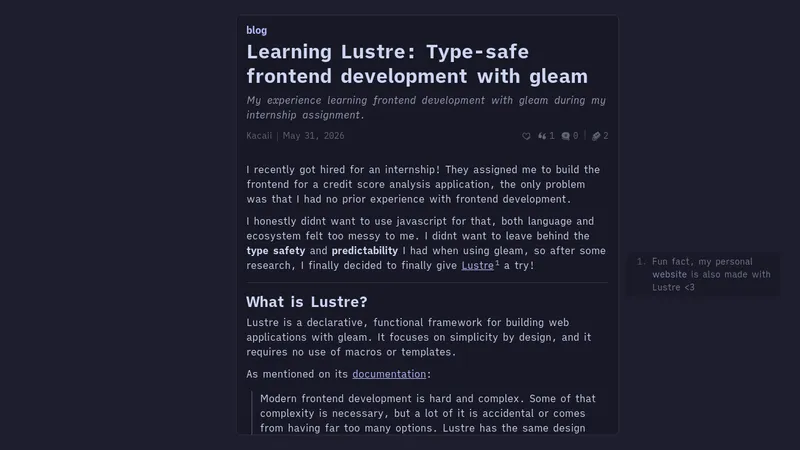 Gleamで実現する型安全な
Lustreは、Gleam言語で構築される宣言的かつ関数型のWebアプリケーションフレームワークです。
従来の複雑なフロントエンドの課題に対し、Lustreはシンプルさを追求し、単一の方法で開発を可能にします。
設計はModel-View-Update(MVU)アーキテクチャに基づき、状態管理はメッセージパッシングによって行われます。
ビューは純粋な関数であり、状態の更新はメッセージに対するパターンマッチングによって行われます。
これにより、Lustreは高い型安全性と予測可能性を提供し、堅牢で保守しやすいフロントエンド開発を可能にします。
原文の冒頭を表示(英語・3段落のみ)
I recently got hired for an internship! They assigned me to build the frontend for a credit score analysis application, the only problem was that I had no prior experience with frontend development.I honestly didnt want to use javascript for that, both language and ecosystem felt too messy to me. I didnt want to leave behind the type safety and predictability I had when using gleam, so after some research, I finally decided to finally give Lustre1 a try!What is Lustre?Lustre is a declarative, functional framework for building web applications with gleam. It focuses on simplicity by design, and it requires no use of macros or templates.As mentioned on its documentation:Modern frontend development is hard and complex. Some of that complexity is necessary, but a lot of it is accidental or comes from having far too many options. Lustre has the same design philosophy as Gleam: where possible, there should be only one way to do things!The Model-View-Update architectureInspired by Elm and erlang, lustre uses message passing2 for managing state, a Lustre application consists of three main parts:1.Model: Your application state. It will be passed to your view function in order to determine how the UI will look like.2.View: Render your HTML elements. User interactions and external events will produces messages that must be handled by your update function.3.Update: Updates your application state. You can pattern match on the messages received by the UI and update the Model.pub type Model
pub type Message
fn init(_props) {
※ 著作権に配慮し、引用は冒頭3段落までです。続きは元記事をご覧ください。