27個の新たな惑星候補を発見:2つの恒星を公転する系外惑星
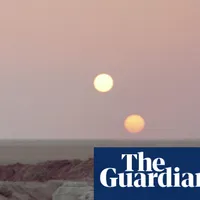
オーストラリア国立科学研究機関(UNSW)の研究チームは、2つの恒星を公転する惑星候補を27個発見したと発表した。
これまで確認されている二重恒星惑星はわずか18個で、今回の発見でその数は大幅に増加する。
研究では、恒星の相互面食のタイミングの変化を捉える「アプサイド予動」という手法を用い、NASAのトランスiting Exoplanet Survey Satellite(TESS)のデータを分析した。
これらの惑星候補は、海王星程度の大きさから木星の10倍以上の重さを持つ可能性がある。
天文学者らが、二つの恒星の周りを公転する「周二星惑星(サーカムバイナリー惑星)」の候補を27個発見したと発表しました。これは、SF作品『スター・ウォーズ』に登場するタトゥイーンのような環境を持つ惑星の存在を示唆するもので、宇宙における惑星探査の新たな可能性を提示しています。
周二星惑星の発見状況と意義
これまで、二つの恒星の周りを公転する周二星惑星は、宇宙全体で約18個しか確認されていませんでした。一方、地球のように単一の恒星の周りを回る惑星は6,000個以上発見されています。今回、研究チームは約30個の候補天体を特定し、周二星惑星の知見を大きく広げることになりました。これらの惑星候補は、地球から650光年から18,000光年という広範囲にわたって存在するとされています。
新たな検出手法「アプサイド前進」
従来の周二星惑星の発見は、惑星が恒星の前を通過する「トランジット」現象を利用していました。しかし、この方法は地球からの視線が完璧に一致した場合に限られるため、多くのシステムを見逃す可能性がありました。今回の研究では、恒星同士が互いを覆い隠す現象のタイミングの微妙なズレ(アプサイド前進)を監視することで、第三の天体(惑星)の存在を推測しています。この手法により、1,590の恒星系の中から36の候補が特定されました。
極限環境と今後の研究課題
発見された惑星候補は、海王星サイズから木星の10倍以上の質量を持つと推定されています。これらの惑星は、太陽系とは全く異なる「極限環境」にあると考えられています。しかし、SFで描かれるタトゥイーンのように、二つの恒星の軌道の「スイートスポット」が存在し、極端に暑すぎず寒すぎない場所で生命が存在する可能性も指摘されています。今後は、これらの天体のスペクトル分析などにより、惑星なのか褐色矮星なのかを正式に確認していく必要があります。
まとめ
今回の発見は、宇宙における惑星の多様性と、従来の検出方法では見えなかった天体を見つけ出す新しい科学的手法が有効であることを示しています。宇宙の神秘を解き明かす上で、非常に興味深い一歩となるでしょう。
原文の冒頭を表示(英語・3段落のみ)
Astronomers have discovered 27 new potential planets that orbit two stars, like the fictional desert planet Tatooine from the Star Wars universe.To date, only about 18 circumbinary planets – which orbit around two stars – had been identified in the universe. More than 6,000 planets have been discovered that orbit single stars, like Earth does around the sun.In a timely publication for 4 May, also known as Star Wars Day, scientists have identified nearly 30 more candidate planets, whose distances range from 650 to 18,000 light years away from Earth.“There are many things in astronomy that aren’t very tangible,” said Assoc Prof Ben Montet of the University of New South Wales (UNSW), the study’s senior author. But thanks to the famous Tatooine sunset scene in the first Star Wars film, “everyone has a picture of what a circumbinary planet looks like and what would it mean to stand on a planet with two suns”.More than half of the stars in the universe exist in binary or multiple star systems. Scientists previously identified circumbinary planets via their transits: when these planets pass in front of a star, “it casts a shadow on the star’s surface, we see a dip in brightness of the star … and we can infer there’s something going around it,” Montet said.But this only happens when the planet and its star perfectly align with our line of sight from Earth. “We’re missing lots of systems, potentially,” Montet said.“Planets are hard to find. It’s like trying to see a candle right next to a big street light.”The researchers instead used a method known as “apsidal precession”, searching for a wobble between stars that orbit around and eclipse each other.“If we monitor the exact timing of these eclipses… that can tell us that there’s something else going on in the system,” said Margo Thornton, the study’s lead author and a PhD candidate at UNSW.After eliminating other factors such as the rotation and gravitational pull of the two stars, the team identified 36 star systems out of 1,590 whose behaviour could only be explained by a third body.For “27 of those objects, it is possible that they are planet mass”, Thornton said. More research into their spectra – the light they emit – was needed to formally confirm them as circumbinary planets, she said. “It’s just a matter of: what is the mass of it? Is it a planet? Is it a brown dwarf? Is it a star?”The team discovered the potential planets – which likely range from Neptune-sized to ten times heavier than Jupiter – using data from Nasa’s Transiting Exoplanet Survey Satellite, a planet-hunting space telescope that launched in 2018.Dr Sara Webb, an astrophysicist at the Swinburne University of Technology who was not involved in the research, said the team’s “very clever techniques” could be used to find more planet candidates in the future.Circumbinary planets would likely have “very extreme environments” unlike anything in our solar system, Webb said. “[But] a planet like Tatooine could potentially exist where there is that sweet spot between its orbit of the two stars – where it’s not too hot and it’s not too cold.”“When the original Star Wars was released, we didn’t know that there were exoplanets [planets outside our solar system] at all.”“A lot of things that are predicted in art and in artistic concepts of what the universe might be, we tend to find it … in science as well.”The research was published in the Monthly Notices of the Royal Astronomical Society.
※ 著作権に配慮し、引用は冒頭3段落までです。続きは元記事をご覧ください。