高伸長性と耐ひずみを持つ電気化学バイオインターフェースの開発
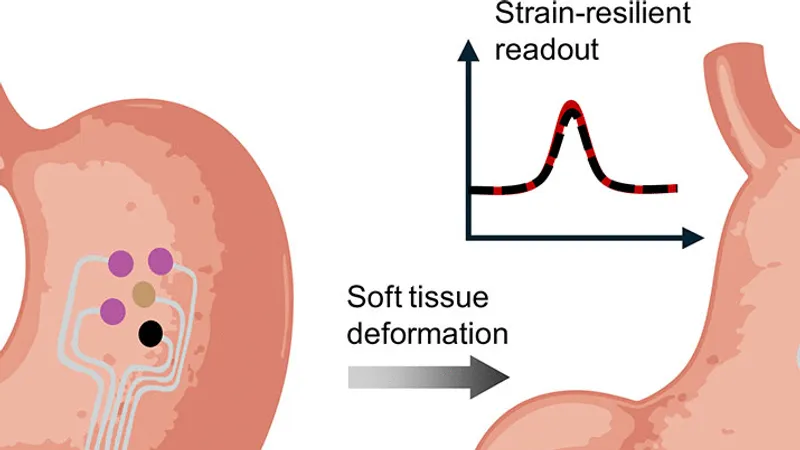 組織変形に対応する化学センサ
従来のソフトバイオエレクトロニクスでは、生体組織の大きな動きによる機械的変形が電気化学的シグナルの歪みを引き起こし、正確な分子センシングを妨げていました。
本研究は、液体金属導体やCNT複合材などからなる三層構造「SIRES」という高伸縮性界面を開発しました。
この構造により、最大の300%のひずみ下でも電気化学的な読み出し安定性を維持し、信号の歪みを抑制します。
これにより、尿酸やグルコースなどの様々な分析物に対するマルチプレックスセンシングが実現され、ウェアラブルや臓器インターフェースでの信頼性の高い生体化学モニタリングへの道筋を確立しました。
原文の冒頭を表示(英語・3段落のみ)
Editor’s summaryThe development of stretchable and foldable materials for bioelectronics has made it possible to fabricate soft, compliant devices for minimally obtrusive biomedical health monitoring. These devices work well with optical or electrical signals but less well when chemical sensing is also required because mechanical distortion of the device can affect these signals in different ways. Xu et al. integrated liquid metals, carbon nanotube–polyurethane composites, and soft functional coatings to achieve strain-resilient molecular sensing in both wearable and implantable configurations. The system maintains stable electrochemical readouts under up to 300% strain. Through modeling and validation studies, including in animals and humans, the authors demonstrated multimodal sensing for a diverse range of analytes. —Marc S. LavineStructured AbstractINTRODUCTIONStretchable bioelectronics enable intimate integration with soft, dynamic tissues and have advanced physical health monitoring by maintaining conformal contact during motion. Extending these advantages to chemical sensing is challenging because electrochemical readouts depend on coupled electrical transport and interfacial reactions, both of which are readily compromised by mechanical deformation. In practice, stretching alters resistance of the electrical circuit, changes the electrochemically active surface area, and modulates interfacial kinetics and mass transport, which together distort voltammetric and amperometric signatures and introduce baseline drift. These deformation-induced artifacts are especially problematic on tissues that undergo large, continuous shape changes—such as skin during daily activity and gastrointestinal organs during peristalsis and distension—where even modest signal instability can compromise quantitative biomarker interpretation. Consequently, reliable molecular sensing on dynamic tissues has remained limited, restricting biomarker-driven wearable and implantable systems that aim to move beyond physical vital signs toward continuous, chemistry-based health monitoring.RATIONALEFor soft, stretchable bioelectronics, robust molecular readouts on moving tissues are challenging. Platforms may rely on nonstretchable substrates or brittle conductors that crack, delaminate, and lose electrical and electrochemical integrity under strain. Deformation further perturbs electrode morphology, electroactive surface area, and ion transport, and functional coatings can fracture or detach, collectively distorting waveforms and degrading fidelity. We reasoned that strain-resilient electrochemical sensing requires a coupled materials-and-circuit strategy that preserves charge transport and electrochemical access during deformation. Accordingly, we designed a fully elastomeric, intrinsically stretchable trilayer interface that offsets strain-induced resistance increases with gains in electroactive area to maintain near-constant total resistance and preserve signal fidelity.RESULTSWe developed a strain-resilient, intrinsically stretchable interface for resilient electrochemical sensing (SIRES) comprising three elastomeric layers: a phase-separated liquid-metal conductor that preserves charge transport, an electrically tunable carbon nanotube–polyurethane interlayer that regulates electromechanical coupling, and a stretchable functional coating that stabilizes bioactive sensing elements. Finite-element analysis and experimental measurements show that stretching slightly increases the active surface area, lowers interfacial impedance, and raises circuit resistance, consistent with modified Randles modeling. We engineered an interface that preserves stable voltammetric, potentiometric, and amperometric signatures under strains up to 300%. We covalently integrated all functional layers within a unified elastomeric architecture that resists delamination and suppresses cracking, sustaining performance during cyclic stretching.We demonstrated modality generality by integrating voltammetric (uric acid), amperometric (glucose, lactate, and hydrogen peroxide), and potentiometric (pH) sensors, together with stretchable counter and reference electrodes, all of which retained stable performance under large strain. Using these components, we assembled a fully stretchable multiplexed wearable system for strain-resilient sweat monitoring, enabling real-time on-body biochemical profiling during exercise across multiple sites. When translated to organ-interfaced applications, the platform maintained conformal contact and robust readouts under organ-level motion, including demonstrations on dynamically deforming tissues and disease-relevant in vivo measurements.CONCLUSIONThis work establishes a general materials-and-circuit strategy for strain-resilient electrochemical sensing. The covalently integrated, all-elastomer architecture conforms to dynamic tissues, and the underlying design rules are extensible to affinity-based modalities and closed-loop bioelectronic systems, enabling strain-insensitive chemical monitoring for wearable and implantable precision diagnostics and therapy.Strain-resilient electrochemical sensing on dynamic soft tissues.An intrinsically stretchable SIRES sensor patch conforms to a deforming organ surface and maintains a stable electrochemical readout during soft-tissue motion. Whereas deformation typically distorts signals by changing circuit resistance and interfacial electrochemistry, SIRES preserves electrochemical signal fidelity under strain, enabling reliable molecular sensing on moving tissues. [Figure created with BioRender.com]AbstractStretchable bioelectronics promise seamless integration with dynamic tissues, yet their electrochemical performance often collapses under strain owing to cracking, interlayer delamination, and signal distortion. We introduce an intrinsically stretchable interface for resilient electrochemical sensing (SIRES) built from a strain-resilient conductor, an electrically tunable interlayer, and a stretchable functional coating. By offsetting strain-induced resistance increases with gains in active surface area, SIRES maintains near-constant resistance and high-fidelity electrochemical readouts under strains up to 300%. The platform supports voltammetric, potentiometric, and amperometric modalities and enables multiplexed molecular monitoring across dynamically deforming tissues in wearable and implantable formats. Its unified architecture provides delamination-resistant interfaces suitable for long-term use, and the design rules generalize to affinity-based transduction, establishing a pathway toward strain-resilient molecular sensing for precision diagnostics and therapy.
Access the full articleView all access options to continue reading this article.Supplementary MaterialsThe PDF file includes:Figs. S1 to S44Tables S1 to S4References (43–63)Download9.10 MBOther Supplementary Material for this manuscript includes the following:MDAR Reproducibility ChecklistDownload486.26 KBReferences and Notes1H. J. Kim, J. H. Koo, S. Lee, T. Hyeon, D.-H. Kim, Materials design and integration strategies for soft bioelectronics in digital healthcare. Nat. Rev. Mater. 10, 654–673 (2025).2S. Liu, Y. Rao, H. Jang, P. Tan, N. Lu, Strategies for body-conformable electronics. Matter 5, 1104–1136 (2022).3J. Liu, N. Liu, Y. Xu, M. Wu, H. Zhang, Y. Wang, Y. Yan, A. Hill, R. Song, Z. Xu, M. Park, Y. Wu, J. L. Ciatti, J. Gu, H. Luan, Y. Zhang, T. Yang, H.-Y. Ahn, S. Li, W. Z. Ray, C. K. Franz, M. R. MacEwan, Y. Huang, C. W. Hammill, H. Wang, J. A. Rogers, Bioresorbable shape-adaptive structures for ultrasonic monitoring of deep-tissue homeostasis. Science 383, 1096–1103 (2024).4J. Shi, S. Kim, P. Li, F. Dong, C. Yang, B. Nam, C. Han, E. Eig, L. L. Shi, S. Niu, J. Yue, B. Tian, Active biointegrated living electronics for managing inflammation. Science 384, 1023–1030 (2024).5Y. Liu, J. Li, S. Song, J. Kang, Y. Tsao, S. Chen, V. Mottini, K. McConnell, W. Xu, Y.-Q. Zheng, J. B.-H. Tok, P. M. George, Z. Bao, Morphing electronics enable neuromodulation in growing tissue. Nat. Biotechnol. 38, 1031–1036 (2020).6Y. Jiang, Z. Zhang, Y.-X. Wang, D. Li, C.-T. Coen, E. Hwaun, G. Chen, H.-C. Wu, D. Zhong, S. Niu, W. Wang, A. Saberi, J.-C. Lai, Y. Wu, Y. Wang, A. A. Trotsyuk, K. Y. Loh, C.-C. Shih, W. Xu, K. Liang, K. Zhang, Y. Bai, G. Gurusankar, W. Hu, W. Jia, Z. Cheng, R. H. Dauskardt, G. C. Gurtner, J. B.-H. Tok, K. Deisseroth, I. Soltesz, Z. Bao, Topological supramolecular network enabled high-conductivity, stretchable organic bioelectronics. Science 375, 1411–1417 (2022).7K.-H. Ha, J. Yoo, S. Li, Y. Mao, S. Xu, H. Qi, H. Wu, C. Fan, H. Yuan, J.-T. Kim, M. T. Flavin, S. Yoo, P. Shahir, S. Kim, H.-Y. Ahn, E. Colgate, Y. Huang, J. A. Rogers, Full freedom-of-motion actuators as advanced haptic interfaces. Science 387, 1383–1390 (2025).8Y. Xu, B. Sun, Y. Ling, Q. Fei, Z. Chen, X. Li, P. Guo, N. Jeon, S. Goswami, Y. Liao, S. Ding, Q. Yu, J. Lin, G. Huang, Z. Yan, Multiscale porous elastomer substrates for multifunctional on-skin electronics with passive-cooling capabilities. Proc. Natl. Acad. Sci. U.S.A. 117, 205–213 (2020).9J. Yin, S. Wang, T. Tat, J. Chen, Motion artefact management for soft bioelectronics. Nat. Rev. Bioeng. 2, 541–558 (2024).10J. Wu, J. Deng, G. Theocharidis, T. L. Sarrafian, L. G. Griffiths, R. T. Bronson, A. Veves, J. Chen, H. Yuk, X. Zhao, Adhesive anti-fibrotic interfaces on diverse organs. Nature 630, 360–367 (2024).11Y. Lin, Y. Fang, J. Yue, B. Tian, Soft–hard composites for bioelectric interfaces. Trends Chem. 2, 519–534 (2020).12Z. Jiang, N. Chen, Z. Yi, J. Zhong, F. Zhang, S. Ji, R. Liao, Y. Wang, H. Li, Z. Liu, Y. Wang, T. Yokota, X. Liu, K. Fukuda, X. Chen, T. Someya, A 1.3-micrometre-thick elastic conductor for seamless on-skin and implantable sensors. Nat. Electron. 5, 784–793 (2022).13Y. Jiang, S. Ji, J. Sun, J. Huang, Y. Li, G. Zou, T. Salim, C. Wang, W. Li, H. Jin, J. Xu, S. Wang, T. Lei, X. Yan, W. Y. X. Peh, S.-C. Yen, Z. Liu, M. Yu, H. Zhao, Z. Lu, G. Li, H. Gao, Z. Liu, Z. Bao, X. Chen, A universal interface for plug-and-play assembly of stretchable devices. Nature 614, 456–462 (2023).14Y. Xu, Y. Su, X. Xu, B. Arends, G. Zhao, D. N. Ackerman, H. Huang, S. P. Reid, J. L. Santarpia, C. Kim, Z. Chen, S. Mahmoud, Y. Ling, A. Brown, Q. Chen, G. Huang, J. Xie, Z. Yan, Porous liquid metal-elastomer composites with high leakage resistance and antimicrobial property for skin-interfaced bioelectronics. Sci. Adv. 9, eadf0575 (2023).15J. Chen, W. Huang, D. Zheng, Z. Xie, X. Zhuang, D. Zhao, Y. Chen, N. Su, H. Chen, R. M. Pankow, Z. Gao, J. Yu, X. Guo, Y. Cheng, J. Strzalka, X. Yu, T. J. Marks, A. Facchetti, Highly stretchable organic electrochemical transistors with strain-resistant performance. Nat. Mater. 21, 564–571 (2022).16D. Zhong, C. Wu, Y. Jiang, Y. Yuan, M. G. Kim, Y. Nishio, C.-C. Shih, W. Wang, J.-C. Lai, X. Ji, T. Z. Gao, Y.-X. Wang, C. Xu, Y. Zheng, Z. Yu, H. Gong, N. Matsuhisa, C. Zhao, Y. Lei, D. Liu, S. Zhang, Y. Ochiai, S. Liu, S. Wei, J. B.-H. Tok, Z. Bao, High-speed and large-scale intrinsically stretchable integrated circuits. Nature 627, 313–320 (2024).17S. H. Kim, A. Basir, R. Avila, J. Lim, S. W. Hong, G. Choe, J. H. Shin, J. H. Hwang, S. Y. Park, J. Joo, C. Lee, J. Choi, B. Lee, K.-S. Choi, S. Jung, T. I. Kim, H. Yoo, Y. H. Jung, Strain-invariant stretchable radio-frequency electronics. Nature 629, 1047–1054 (2024).18Y. Xu, Z. Ye, G. Zhao, Q. Fei, Z. Chen, J. Li, M. Yang, Y. Ren, B. Berigan, Y. Ling, X. Qian, L. Shi, I. Ozden, J. Xie, W. Gao, P.-Y. Chen, Z. Yan, Phase-separated porous nanocomposite with ultralow percolation threshold for wireless bioelectronics. Nat. Nanotechnol. 19, 1158–1167 (2024).19N. Brasier, J. Wang, W. Gao, J. R. Sempionatto, C. Dincer, H. C. Ates, F. Güder, S. Olenik, I. Schauwecker, D. Schaffarczyk, E. Vayena, N. Ritz, M. Weisser, S. Mtenga, R. Ghaffari, J. A. Rogers, J. Goldhahn, Applied body-fluid analysis by wearable devices. Nature 636, 57–68 (2024).20D. S. Yang, R. Ghaffari, J. A. Rogers, Sweat as a diagnostic biofluid. Science 379, 760–761 (2023).21J. R. Sempionatto, J. A. Lasalde-Ramírez, K. Mahato, J. Wang, W. Gao, Wearable chemical sensors for biomarker discovery in the omics era. Nat. Rev. Chem. 6, 899–915 (2022).22M. Friedel, I. A. P. Thompson, G. Kasting, R. Polsky, D. Cunningham, H. T. Soh, J. Heikenfeld, Opportunities and challenges in the diagnostic utility of dermal interstitial fluid. Nat. Biomed. Eng. 7, 1541–1555 (2023).23W. Heng, S. Yin, J. Min, C. Wang, H. Han, E. Shirzaei Sani, J. Li, Y. Song, H. B. Rossiter, W. Gao, A smart mask for exhaled breath condensate harvesting and analysis. Science 385, 954–961 (2024).24C. Ye, M. Wang, J. Min, R. Y. Tay, H. Lukas, J. R. Sempionatto, J. Li, C. Xu, W. Gao, A wearable aptamer nanobiosensor for non-invasive female hormone monitoring. Nat. Nanotechnol. 19, 330–337 (2024).25M. Wang, C. Ye, Y. Yang, D. Mukasa, C. Wang, C. Xu, J. Min, S. A. Solomon, J. Tu, G. Shen, S. Tang, T. K. Hsiai, Z. Li, J. S. McCune, W. Gao, Printable molecule-selective core-shell nanoparticles for wearable and implantable sensing. Nat. Mater. 24, 589–598 (2025).26J. Min, H. Ahn, H. Lukas, X. Ma, R. Bhansali, S.-H. Sunwoo, C. Wang, Y. Xu, D. R. Yao, G. Kim, Z. Li, T. K. Hsiai, A. Emami, H.-T. Jung, W. Gao, Continuous biochemical profiling of the gastrointestinal tract using an integrated smart capsule. Nat. Electron. 8, 844–855 (2025).27Y. Zhao, B. Wang, J. Tan, H. Yin, R. Huang, J. Zhu, S. Lin, Y. Zhou, D. Jelinek, Z. Sun, K. Youssef, L. Voisin, A. Horrillo, K. Zhang, B. M. Wu, H. A. Coller, D. C. Lu, Q. Pei, S. Emaminejad, Soft strain-insensitive bioelectronics featuring brittle materials. Science 378, 1222–1227 (2022).28J. Li, M. Jiang, M. Su, L. Tian, W. Shi, C. Yu, Stretchable and transparent electrochemical sensor based on nanostructured Au on carbon nanotube networks for real-time analysis of H2O2 release from cells. Anal. Chem. 93, 6723–6730 (2021).29S. Y. Oh, S. Y. Hong, Y. R. Jeong, J. Yun, H. Park, S. W. Jin, G. Lee, J. H. Oh, H. Lee, S.-S. Lee, J. S. Ha, Skin-attachable, stretchable electrochemical sweat sensor for glucose and pH detection. ACS Appl. Mater. Interfaces 10, 13729–13740 (2018).30E. Shirzaei Sani, C. Xu, C. Wang, Y. Song, J. Min, J. Tu, S. A. Solomon, J. Li, J. L. Banks, D. G. Armstrong, W. Gao, A stretchable wireless wearable bioelectronic system for multiplexed monitoring and combination treatment of infected chronic wounds. Sci. Adv. 9, eadf7388 (2023).31J. Xu, Z. Zhang, S. Gan, H. Gao, H. Kong, Z. Song, X. Ge, Y. Bao, L. Niu, Highly stretchable fiber-based potentiometric ion sensors for multichannel real-time analysis of human sweat. ACS Sens. 5, 2834–2842 (2020).32F. Han, H. Li, L. Huang, X. Zhou, R. Su, H. Yu, Q. Tian, H. Zhao, Q. Li, J. Sun, M. Yu, X. Deng, G. Li, H. Ye, F. Li, G. Zhang, Z. Liu, Hybrid microstructure-based stretchable biosensors for multi-physiological signal sensing. eScience 5, 100327 (2024).33A. J. Bard, L. R. Faulkner, H. S. White, Electrochemical Methods: Fundamentals and Applications (Wiley, 2022).34H. L. B. Boström, I. E. Collings, D. Daisenberger, C. J. Ridley, N. P. Funnell, A. B. Cairns, Probing the influence of defects, hydration, and composition on Prussian Blue Analogues with pressure. J. Am. Chem. Soc. 143, 3544–3554 (2021).35S. Gong, L. W. Yap, B. Zhu, Q. Zhai, Y. Liu, Q. Lyu, K. Wang, M. Yang, Y. Ling, D. T. H. Lai, F. Marzbanrad, W. Cheng, Local crack‐programmed gold nanowire electronic skin tattoos for in‐plane multisensor integration. Adv. Mater. 31, e1903789 (2019).36W. Gao, S. Emaminejad, H. Y. Y. Nyein, S. Challa, K. Chen, A. Peck, H. M. Fahad, H. Ota, H. Shiraki, D. Kiriya, D.-H. Lien, G. A. Brooks, R. W. Davis, A. Javey, Fully integrated wearable sensor arrays for multiplexed in situ perspiration analysis. Nature 529, 509–514 (2016).37J. Heikenfeld, A. Jajack, J. Rogers, P. Gutruf, L. Tian, T. Pan, R. Li, M. Khine, J. Kim, J. Wang, J. Kim, Wearable sensors: Modalities, challenges, and prospects. Lab Chip 18, 217–248 (2018).38M. Bariya, H. Y. Y. Nyein, A. Javey, Wearable sweat sensors. Nat. Electron. 1, 160–171 (2018).39K. Bootsma, M. M. Fitzgerald, B. Free, E. Dimbath, J. Conjerti, G. Reese, D. Konkolewicz, J. A. Berberich, J. L. Sparks, 3D printing of an interpenetrating network hydrogel material with tunable viscoelastic properties. J. Mech. Behav. Biomed. Mater. 70, 84–94 (2017).40R. K. Goyal, Y. Guo, H. Mashimo, Advances in the physiology of gastric emptying. Neurogastroenterol. Motil. 31, e13546 (2019).41B. Remund, B. Yilmaz, C. Sokollik, D-lactate: Implications for gastrointestinal diseases. Children (Basel) 10, 945 (2023).42M. López-Lázaro, Dual role of hydrogen peroxide in cancer: Possible relevance to cancer chemoprevention and therapy. Cancer Lett. 252, 1–8 (2007).43R. Wang, Q. Zhai, Y. Zhao, T. An, S. Gong, Z. Guo, Q. Shi, Z. Yong, W. Cheng, Stretchable gold fiber-based wearable electrochemical sensor toward pH monitoring. J. Mater. Chem. B 8, 3655–3660 (2020).44R. Rahimi, M. Ochoa, A. Tamayol, S. Khalili, A. Khademhosseini, B. Ziaie, Highly stretchable potentiometric pH sensor fabricated via laser carbonization and machining of carbon-polyaniline composite. ACS Appl. Mater. Interfaces 9, 9015–9023 (2017).45L. Yin, M. Cao, K. N. Kim, M. Lin, J.-M. Moon, J. R. Sempionatto, J. Yu, R. Liu, C. Wicker, A. Trifonov, F. Zhang, H. Hu, J. R. Moreto, J. Go, S. Xu, J. Wang, A stretchable epidermal sweat sensing platform with an integrated printed battery and electrochromic display. Nat. Electron. 5, 694–705 (2022).46Q. Zhai, L. W. Yap, R. Wang, S. Gong, Z. Guo, Y. Liu, Q. Lyu, J. Wang, G. P. Simon, W. Cheng, Vertically aligned gold nanowires as stretchable and wearable epidermal ion-selective electrode for noninvasive multiplexed sweat analysis. Anal. Chem. 92, 4647–4655 (2020).47S. Kim, J. Kang, I. Lee, J. Jang, C. B. Park, W. Lee, B.-S. Bae, An intrinsically stretchable multi-biochemical sensor for sweat analysis using photo-patternable ecoflex. npj Flex. Electron. 7, 33 (2023).48G. Zhao, Z. Chen, S. Wang, S. Chen, F. Zhang, S. M. Andrabi, Y. Xu, Q. Ouyang, M. E. B. Rosas, X. Qian, J. Xie, Z. Yan, Sustainable nanofibril interfaces for strain-resilient and multimodal porous bioelectronics. Adv. Mater. 36, e2411587 (2024).49H. Lee, T. K. Choi, Y. B. Lee, H. R. Cho, R. Ghaffari, L. Wang, H. J. Choi, T. D. Chung, N. Lu, T. Hyeon, S. H. Choi, D.-H. Kim, A graphene-based electrochemical device with thermoresponsive microneedles for diabetes monitoring and therapy. Nat. Nanotechnol. 11, 566–572 (2016).50Z.-H. Jin, Y.-L. Liu, J.-J. Chen, S.-L. Cai, J.-Q. Xu, W.-H. Huang, Conductive polymer-coated carbon nanotubes to construct stretchable and transparent electrochemical sensors. Anal. Chem. 89, 2032–2038 (2017).51J. R. Sempionatto, M. Lin, L. Yin, E. De la Paz, K. Pei, T. Sonsa-Ard, A. N. de Loyola Silva, A. A. Khorshed, F. Zhang, N. Tostado, S. Xu, J. Wang, An epidermal patch for the simultaneous monitoring of haemodynamic and metabolic biomarkers. Nat. Biomed. Eng. 5, 737–748 (2021).52J. Li, Y. Liu, L. Yuan, B. Zhang, E. S. Bishop, K. Wang, J. Tang, Y.-Q. Zheng, W. Xu, S. Niu, L. Beker, T. L. Li, G. Chen, M. Diyaolu, A.-L. Thomas, V. Mottini, J. B.-H. Tok, J. C. Y. Dunn, B. Cui, S. P. Pașca, Y. Cui, A. Habtezion, X. Chen, Z. Bao, A tissue-like neurotransmitter sensor for the brain and gut. Nature 606, 94–101 (2022).53C. A. Silva, J. lv, L. Yin, I. Jeerapan, G. Innocenzi, F. Soto, Y.-G. Ha, J. Wang, Liquid metal based island‐bridge architectures for all printed stretchable electrochemical devices. Adv. Funct. Mater. 30, 2002041 (2020).54T. Lim, H. Zhang, Multilayer carbon nanotube/gold nanoparticle composites on gallium-based liquid metals for electrochemical biosensing. ACS Appl. Nano Mater. 4, 12690–12701 (2021).55R. Sha, N. Vishnu, S. Badhulika, MoS2 based ultra-low-cost, flexible, non-enzymatic and non-invasive electrochemical sensor for highly selec
※ 著作権に配慮し、引用は冒頭3段落までです。続きは元記事をご覧ください。