自動運転技術が切り拓く物流の未来:巨大な可能性を秘めた商用トラック
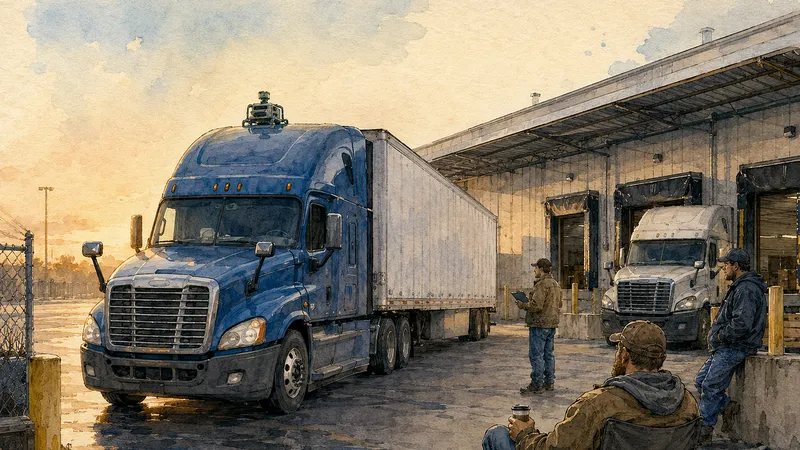 自動トラックの超低コスト革命
Bot Auto社が完全無人状態の商用トラックを230マイル走行させることに成功し、この運行は1マイルあたり2ドル未満という驚異的なコスト効率を達成しました。
トラックは、承認された動作境界を逸脱した場合に、減速や安全な状態移行を行う「リスク軽減状態」に入ることで安全性を確保しています。
大手物流企業は中距離輸送(ミドルマイル)で自動化を進めていますが、現時点ではラストマイル配送には人間の運転手が不可欠です。
技術的なハードルは狭まりつつありますが、全米レベルでの運行には、安全性に対する懸念と複雑な法規制、政治的な枠組みが課題として残っています。
原文の冒頭を表示(英語・3段落のみ)
An eighteen-wheeler drove itself 230 miles. The future of trucking is here (sort of).4 min read5 hours ago--Press enter or click to view image in full sizeImage generated with AIA truck left Riggy’s Truck Parking in northeast Houston late one night this week. It drove 230 miles north on I-45 and pulled into Hutchins, Texas, just south of Dallas. Nobody sat in the driver’s seat. No observer rode along, and no remote operator was waiting on a screen to rescue it.Bot Auto, the company that built the truck, is calling this the first fully humanless commercial truckload in the United States. The customer was Ryan Transportation, a freight brokerage.And the headline that matters most to business owners across the nation: the cost worked out to under two dollars per mile.The future of moving deliverables is quickly approaching, and with the rising price of oil not a moment too soon. But giant autonomous trucks on the road bring a new dimension to our often well-founded fears about autonomous safety. We’ve had a slew of autonomous and semi-autonomous vehicles enter the space in the past couple of years, but if you’ve ever looked up at a semi next to you on the freeway, your hand gripping more tightly onto the wheel just to make sure you don’t veer a little too much towards the giant tin monster, you can probably feel why this one hits different.Bot Auto’s CEO, Xiaodi Hou, in an effort to assuage some of those fears, talked about how the truck behaves when it gets confused, saying, “If it reached a condition outside its approved operating boundary, it would enter a mitigated risk condition: slow down, create space, and bring itself to a controlled safe state.”The phrase “approved operating boundary” is doing a lot of heavy lifting. There’s still a lot of risk inside the operating boundary, with plenty of kinks to work out, especially if we’re going to have these trucks on the road along with our loved ones while no one’s in the driver’s seat. The lights are on, but nobody’s home suddenly takes on new meaning.Reporting by CNBC pointed at the larger shape of what’s coming next. McLane, the Berkshire Hathaway distribution company with more than 80 distribution centers and 25,000 employees, has approved driverless operations with Aurora Innovation on its Dallas-to-Houston freight route. Aurora’s tech handles the middle mile. McLane’s own drivers, on different trucks, still handle last-mile delivery. CNBC also noted a complication: current Aurora/McLane routes still carry a human observer in the cab who does not operate the vehicle. Aurora plans to deploy 200 trucks without observers by year-end.Susan Adzick, McLane Restaurant president, framed it as autonomous tech driving efficiency on the supply chain while McLane’s drivers stay focused on “the critical last mile” and on serving as “the face of the company to customers.”That’s the current shape. Long highway stretches between distribution hubs are where the automation pressure shows up first. And if you’ve ever been on the highway in the middle of the night, surrounded by eighteen wheelers commanded by drivers who are trying to push those last few hundred miles but clearly experiencing fatigue, you can appreciate that an automated system that never tires may be an attractive alternative.The last leg, however, is a different beast entirely. The delivery notes don’t always match the building. The receiver may not be where the map thinks he is. Sometimes the driver is just calling from the parking lot asking which side has the dock. Those are ordinary delivery problems, not highway-mile problems.What changes in the near term is what corridors get bid on. Bot Auto’s run came in under two dollars per mile, by Hou’s accounting. Freight buyers notice cheap miles. If a specific lane between Houston and Dallas is cheaper without a driver, somebody is going to try to buy it that way. That doesn’t tell you what happens to every trucker in the country, but it tells you where the pressure starts.Which brings up an important point, because this is about more than engineering marvels. It’s about the human behind the wheel, earning a living. Bot Auto ran in Texas after the state created a commercial autonomous-vehicle authorization program in 2025.In California, the same technology hit a few additional speedbumps. Teamsters California called the state’s new driverless-truck rules rushed and reckless.But California Governor Gavin Newsom vetoed a 2023 bill that would have banned driverless testing and operations of heavy-duty autonomous vehicles, and late last month the California DMV adopted rules allowing them onto the road anyway.Across the nation it’s a mixed bag of competing interests.Washington itself, surprising absolutely no one, wants to have their say on the matter, too. Representative Bob Latta of Ohio introduced the SELF DRIVE Act on February 5th after a January discussion draft. FreightWaves describes the bill as a federal framework for fully autonomous heavy-duty trucks, limited commercial freight under testing permits, and preemption of conflicting state rules. If some version passes, the map of where automation goes next is political as much as it is technical.We see a lot of industry-disruption headlines, and plenty are early or overblown. This one still feels different because the hard parts are narrowing. The last-mile mess is still messy, but companies are very good at turning mess into a routing problem when the savings get large enough. That leaves the politics doing some braking while the business case gets cleaner.In the meantime, the next time a big rig drives past you on the highway, be sure to look up and see if there’s still someone to make eye contact with behind the wheel.
※ 著作権に配慮し、引用は冒頭3段落までです。続きは元記事をご覧ください。