学習管理システム「Canvas」のデータ収集と倫理
 Canvasデータ収集の課題
アメリカや国際的な大学で広く利用されている学習管理システム「Canvas」の開発を分析した結果、K12、高等教育、就業データ間のデータ連携、サードパーティアプリとの連携、プライバシーとセキュリティ上の脆弱性、予測分析などの問題点が浮き彫りになった。
高等教育機関はCanvasの使用に伴うデータ収集や搾取から学生や教職員を保護できていない。
アルゴリズムの透明性向上と倫理的・法的保護の必要性が指摘されている。
アメリカで広く利用されている学習管理システム(LMS)「Canvas」のデータ収集と利用に関する問題点を指摘する研究が発表されました。Canvasは、K-12(幼稚園から高校)教育から高等教育機関まで、幅広い分野で採用されており、学生や教員の学習データを大量に収集しています。この研究では、Canvasの進化過程を分析し、データ収集の透明性やプライバシー保護の観点から懸念を示唆しています。
学習管理システムとデータ収集の拡大
Canvas LMSは、Instructure社が開発した学習管理システムで、アメリカをはじめとする世界中の教育機関で広く利用されています。学習管理システムとは、オンライン授業の実施や課題の提出、成績管理などを一元的に行うためのプラットフォームです。Canvasは、学生の学習履歴、成績、行動パターンなど、膨大なデータを収集していますが、これらのデータがどのように利用されているのか、学生や教員に十分に説明されていないとのことです。特に、K-12教育から高等教育、そして就業市場まで、データを横断的に利用できる仕組みが構築されている点が問題視されています。
データ連携とプライバシーリスク
Canvas LMSは、他のアプリケーションとの連携機能を備えており、様々なサービスとデータを共有することが可能です。これにより、学習データが複数のプラットフォームに分散し、プライバシーリスクが高まる可能性があります。また、データ収集に関する変更が、事前に告知されないままプラットフォームのデザインや機能に組み込まれることも指摘されています。教育機関は、学生や教員の個人情報を保護するための十分な知識や体制が整っていない現状があるようです。
予測分析とアルゴリズムの透明性
Canvas LMSでは、収集されたデータに基づいた予測分析(プレディクティブアナリティクス)が行われています。例えば、学生の学習状況から将来の成績を予測したり、学習サポートを最適化したりすることが可能になります。しかし、予測分析のアルゴリズムがブラックボックス化されており、その仕組みやバイアスの影響が不明確であるため、倫理的な問題や差別が生じるリスクも懸念されています。研究では、アルゴリズムの透明性を確保し、倫理的・法的保護を強化するよう呼びかけています。
まとめ
Canvas LMSのデータ収集と利用に関する問題は、教育機関だけでなく、学生や教員、そして社会全体で認識し、議論していく必要があります。データ収集の透明性を高め、プライバシー保護を徹底するとともに、アルゴリズムの倫理的な影響についても検証していくことが求められます。
原文の冒頭を表示(英語・3段落のみ)
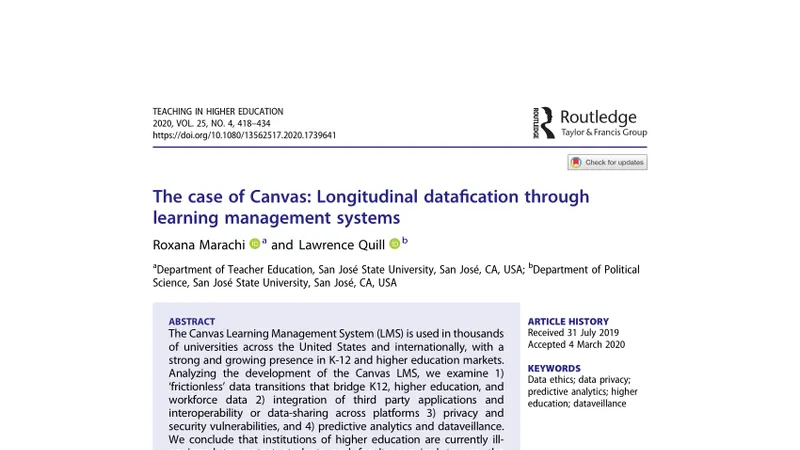
The Canvas Learning Management System (LMS) is used in thousands of universities across the United States and internationally, with a strong and growing presence in K-12 and higher education markets. Analyzing the development of the Canvas LMS, we examine 1) ‘frictionless’ data transitions that bridge K12, higher education, and workforce data 2) integration of third party applications and interoperability or data-sharing across platforms 3) privacy and security vulnerabilities, and 4) predictive analytics and dataveillance. We conclude that institutions of higher education are currently ill-equipped to protect students and faculty required to use the Canvas Instructure LMS from data harvesting or exploitation. We challenge inevitability narratives and call for greater public awareness concerning the use of predictive analytics, impacts of algorithmic bias, need for algorithmic transparency, and enactment of ethical and legal protections for users who are required to use such software platforms. Discover the world's research25+ million members160+ million publication pages2.3+ billion citationsJoin for free
The case of Canvas: Longitudinal datafication throughlearning management systemsRoxana Marachiaand Lawrence QuillbaDepartment of Teacher Education, San José State University, San José, CA, USA;bDepartment of PoliticalScience, San José State University, San José, CA, USAABSTRACTThe Canvas Learning Management System (LMS) is used in thousandsof universities across the United States and internationally, with astrong and growing presence in K-12 and higher education markets.Analyzing the development of the Canvas LMS, we examine 1)‘frictionless’data transitions that bridge K12, higher education, andworkforce data 2) integration of third party applications andinteroperability or data-sharing across platforms 3) privacy andsecurity vulnerabilities, and 4) predictive analytics and dataveillance.We conclude that institutions of higher education are currently ill-equipped to protect students and faculty required to use theCanvas Instructure LMS from data harvesting or exploitation. Wechallenge inevitability narratives and call for greater publicawareness concerning the use of predictive analytics, impacts ofalgorithmic bias, need for algorithmic transparency, and enactmentof ethical and legal protections for users who are required to usesuch software platforms.ARTICLE HISTORYReceived 31 July 2019Accepted 4 March 2020KEYWORDSData ethics; data privacy;predictive analytics; highereducation; dataveillanceIntroductionThe Canvas Learning Management System (LMS) is used in thousands of universities acrossthe United States and internationally, with a strong and growing presence in the K-12 andhigher education markets. Massive amounts of data are gathered continuously on studentsand faculty often without their awareness or consent. On a regular basis, changes are madeto platform design features and analytics without formal announcement or notification.This paper examines the datafication of higher education through the Canvas LMS.While there is growing interest in educational data-mining in K-12 environments (seeManolev, Sullivan, and Slee 2018) relatively little has been written about the growingmarkets for parallel and connected technologies across and beyond early learning, K12,and higher education sectors. With markets currently steeped in artificial intelligenceand attempts at predictive modeling, longitudinal datasets are an increasingly valuablecommodity and ripe for extraction by private companies.Analyzing the development of the Canvas LMS we examine 1) ‘frictionless’data tran-sitions that bridge pre-K, K12, higher education, and workforce data 2) the integration ofconnected third party applications within the LMS, and interoperability or data-sharing© 2020 Informa UK Limited, trading as Taylor & Francis GroupCONTACT Roxana Marachi [email protected] Department of Teacher Education, San José State University,San José, CA, USAThis article has been republished with minor changes. These changes do not impact the academic content of the article.TEACHING IN HIGHER EDUCATION2020, VOL. 25, NO. 4, 418–434https://doi.org/10.1080/13562517.2020.1739641
across these applications 3) privacy and security vulnerabilities, and 4) predictive analyticsand dataveillance.We conclude that institutions of higher education are currently ill-equipped to protectstudents and faculty required to use the Canvas Instructure LMS from data harvesting orexploitation. We challenge inevitability narratives for blind adoptions of such systemsand call for greater public awareness among members of college and university communitiesconcerning the use of predictive behavioral and learning analytics, the impact of algorithmicbias, the need for algorithmic transparency, and enactment of both ethical and legal protec-tions for users who are required to use such software platforms in educational settings.We situate our own discussion between the ongoing debate within the educational tech-nology sector as it attempts to apply its business models to public higher education, theeconomic advantages afforded to (often cash-strapped) public institutions of higher edu-cation, which seek to promote online courses and degrees while simultaneously encouragingfaculty to switch to the new platform, and those academic sectors that embrace educationaltechnology and seek to promote its use often for ideological purposes (Apple 2004,2005,2007; Boggs and Van Baalen-Wood 2018; Fathema, Shannon, and Ross 2015). We alsorefer frequently to San José State University, our home institution, as a prime example ofa university that finds itself caught between the competing and often conflicting demandsof legislators, educational administrators, faculty, parents, and students.A brief history of CanvasThe rise of the Internet has fundamentally altered teaching and learning. The possibility ofproviding online content directly to students of higher education has opened up vastmarkets for professional certificates, executive education, and degrees beyond the kindsthat have historically been granted at colleges and universities. Proponents of EducationalData Management (EDM) claim that it enables real-time assessment of students andmaterials, and allows institutions to assess the effectiveness of learning strategies, which,in some instances might extend to physically tracking students (through the use ofRFID tags in student IDs) and analysing social networks, thereby adapting content tosupport individuated learning. Using these data to assist in instruction, advising, andresource allocation within institutions is now commonplace (Rubel and Jones 2016).Initially adopted by the Utah Education Network, Canvas by Instructure is now themost widely used LMS provider in the United States and Canada and is only third toGoogle and Microsoft in the amount of student data amassed (Menard 2019). It cancount not just K-12 schools, colleges and universities among its clients but also high-profile corporations like Cisco, which teamed up with Canvas in 2012 for integrationinto its Cisco Networking Academy with over one million students worldwide. In fact,Canvas’reach is truly global with an increasing focus since 2013 upon new educationalmarkets in Central and South America, Africa, Europe, and Asia (see Hill 2017).Started in Utah by two graduate students who designed a Learning ManagementSystem as a class project, Canvas’approach was significantly different from that under-taken by early advocates of educational software. Instead of designing a completesystem for a single institution and adapting the technology for subsequent clients, theopen source approach developed by Canvas offered a suite of services according to needalong with a number of third-party applications offered free of charge.TEACHING IN HIGHER EDUCATION 419
※ 著作権に配慮し、引用は冒頭3段落までです。続きは元記事をご覧ください。