廉价深海潜水器或将推动深海科学与采矿
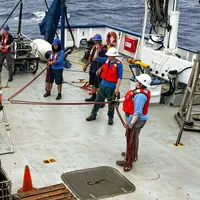
一家名为Orpheus Ocean的公司正在研发廉价的深海潜水器,以降低深海探索的成本。
其首个项目与美国国家海洋和大气管理局(NOAA)合作,利用新型潜水器在太平洋海底进行勘探,寻找关键矿物资源。
这些潜水器成本仅为现有设备的几分之一,且具备采集海底沉积物样本的能力。
Orpheus的潜水器结合了自主水下车(AUV)和遥控水下机器人(ROV)的优点,未来有望促进深海科学研究的普及,并吸引深海采矿等商业领域的兴趣。
尽管还存在挑战,但这项技术有潜力改变深海探索的方式。
查看原文开头(英文 · 仅前 3 段)
A company called Orpheus Ocean wants to go “deep for cheap.”May 1, 2026Crew lower an Orpheus vehicle back on board during a previous mission.Ocean Exploration Trust (OET) Smack dab between Australia and South America, the US National Oceanic and Atmospheric Administration (NOAA) research vessel Rainier is currently on a mission to map more than 8,000 square nautical miles of the Pacific seafloor in search of critical mineral deposits. But it isn’t doing it alone; for a month starting this week, it will deploy two oblong neon submersibles as the project’s special agents, sending them nearly 6,000 meters down to hop along the seafloor. The submersibles, built by the young company Orpheus Ocean, are designed to explore just this environment: a squelchy substrate that teems with life of all kinds, from tiny microbes to worms and snails, along with egg-size “nodules” of metals—such as copper, cobalt, nickel, and manganese—that are crucial for technologies worldwide. Scientists and companies have long sought to probe the deep sea and bring such treasures to the surface. Orpheus, which spun off from the Woods Hole Oceanographic Institution (WHOI) in 2024, could be well positioned to make those possibilities a lot more economical. The company has designed its vehicles on a simple philosophy: “deep for cheap,” says Jake Russell, Orpheus’s cofounder and CEO, who is a chemist by training. The vehicles cost a couple of hundred thousand dollars each to build, whereas existing options can range from $5 million to $10 million. And unlike most autonomous ocean vehicles, they can push into the seafloor and capture cores of sediment—and the creatures within. Orpheus’s engineers have been tinkering with their deep-sea designs for years, much of the work taking place at WHOI and in collaboration with NOAA and the National Aeronautics and Space Administration. Its prototype vehicles were rated capable of diving to 11,000 meters—the deepest part of the Mariana Trench. They’ve completed two commercial deployments, but this new expedition marks the submersibles’ biggest test yet: operating over large ranges for multiple weeks and with multiple instruments at play. Using Rainier as their home base on the ocean’s surface, the vehicles will swim out for 10 kilometers at a time, taking one high-resolution image every second and up to eight physical samples from the seafloor apiece.
If all goes well, the test could help establish the vehicles as a tool for government agencies, scientists, and companies that hope to probe the vastly understudied deep sea and the resources it holds. And while they’re not the only option on the market, Orpheus hopes their size and low building cost will soon make them one of the most accessible. At present, to reach these depths scientists must wait for time on a limited and expensive set of submersibles owned by government agencies and research institutes. That formula lends itself better to capturing snapshots of the deep sea than it does to probing its interconnected ecological and biogeochemical systems. “A lot of this region that we're surveying … has really never been explored in any kind of detail,” says Russell. “Anything we see is going to be new to NOAA and new to science.”
A sediment specialist The Orpheus subs are classified as autonomous underwater vehicles (AUVs), which operate on a mix of preprogrammed commands and live decision-making and without being tethered to a ship. But unlike traditional AUVs engineered for long-distance, high-speed gliding, these submersibles are short and stout with little legs—better for making soft landings on the seafloor and then pushing into the mud to suck out sediment cores for scientists. When they do land, the submersibles can lift off the surface, thrust a few feet, and settle once more in a “hopping” fashion. Their bodies are made mostly of a buoyant material known as syntactic foam, with the important electronics encased in a thick sphere of glass. The same kind of foam, which is interspersed with hollow microspheres of glass to prevent it from collapsing under high pressures, went to the deep in the vehicle that carried the filmmaker James Cameron to the Mariana Trench in 2012; he even donated leftover material for use in earlier Orpheus prototypes.
※ 出于版权考虑,仅引用前 3 段。完整内容请阅读原文。