资本主义制度金字塔 (1911)
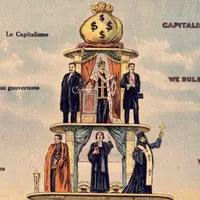
这幅1911年的“资本主义制度金字塔”图像,旨在用古埃及金字塔的建造方式来比喻资本主义制度的等级压迫。
图像描绘了一个分层的社会结构,从顶部的资本主义制度(象征为 $$)开始,向下依次为政治家、宗教阶层、国家机器、富人阶层,底层则是支撑整个金字塔的工人阶级。
它借用俄国社会主义联盟的早期讽刺画以及比利时劳工党的“可推倒的金字塔”的灵感,表达了对资本主义制度的批判和对社会主义、共产主义的期盼。
这幅画由克利夫兰的 Nedeljkovich、Brashich 和 Kuharich 团队创作,他们是塞尔维亚移民,通过《工业工人报》发表。
查看原文开头(英文 · 仅前 3 段)
Even the greatest monuments from the ancient world are no match for the accomplishments of capitalism, when the bourgeoisie became “the first to show what man’s activity can bring about”, as Marx and Engels write in The Communist Manifesto. “It has accomplished wonders far surpassing Egyptian pyramids, Roman aqueducts, and Gothic cathedrals; it has conducted expeditions that put in the shade all former Exoduses of nations and crusades”, and it has done so by “constantly revolutionising the instruments of production, and thereby the relations of production, and with them the whole relations of society.” What if, they wondered, another form of society were possible, were these same revolutionary technologies seized by a different class and employed toward other ends?In 1911, the image of enslaved laborers raising monumental pyramids for their ruling pharaohs was repurposed to visualize the stratification of the capitalist system. Published in Industrial Worker — a newspaper out of Cleveland, Ohio, that was funded by the Industrial Workers of the World (IWW) — the image is a layer cake of oppression. At the top sits the system itself, capitalism, a giant sack embroidered with $$$. Below are the politicians and monarchs (“we rule you”), standing on the shoulders of the priestly caste, who ideologically uphold the status quo (“we fool you”). And below the priests is the repressive apparatus of the state — military and police — who discipline bodies (“we shoot at you”) the way that religion indentures the spirit and mind. And below them are the rich, drunkenly dining on the surplus value stolen from workers by the capitalist system (“we eat for you”). And finally, the lynchpin of the system itself, the class upon whom the whole pyramid depends (“we work for all”, “we feed all”). Some workers take the forms of telemons, bearing the weight of the economic world on their shoulders like Atlas. Others have begun to free themselves from this crushing exploitation, waving the red flag of socialism and communism, protesting with shovels and hammers in hand. The Pyramid of Capitalist System is credited to Nedeljkovich, Brashich, & Kuharich, a Cleveland-based firm. Not a lot known is about the publisher trio but they appear to be Serbian immigrants: likely the tailor John Nedeljkovich, the cook (later restaurant proprietor) Charles Brashich, and Charles Kuharich, owner of the International Publishing Company, a firm focused on socialist magazines (e.g., Industrial Worker) and other radical socialist imagery, such as The Tree of Evil (1912) and The Last Strike (1912). Their 1911 capitalist pyramid is an homage to a 1901 caricature of Imperial Russian society by Nicolas Lokhoff — issued by the Union of Russian Socialists, here an imperial eagle prefigures capitalism’s coin sack — which, in turn, seems to reimagine a 1900 cartoon from the Belgian Labor Party of a pyramide à renverser, a pyramid that must be overthrown.Scroll through the whole page to download all images before printing.“The Pyramid to Overthrow”, ca. 1925 German reprint of the Belgian Labor Party’s 1900 cartoon — Source.Scroll through the whole page to download all images before printing.1901 caricature of Imperial Russian society by Nicolas Lokhoff — Source.An acquaintance of Lenin, Lokhoff styled his workers pointing upward, conscious of their oppression by the ruling class. And their revolutionary flag bears a text written in the style of Russian used before the orthographic reform. Unlike in the American version of the image, these workers have a call to arms: Жить въ свободѣ / Умереть въ борьбѣ, “[to] live free [in freedom], [to] die for the struggle/fight/cause”. A poetic stanza elaborates: “The time will come when the people in their fury will straighten their bent backs and bring down the structure with one mighty push of their shoulders”.
※ 出于版权考虑,仅引用前 3 段。完整内容请阅读原文。