量子计算机助力寻找无需稀土元素的磁铁
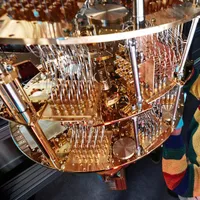
全球研究人员正致力于开发一种无需使用稀土元素的、经济高效且强大的永磁体。
目前永磁体主要依赖稀土元素,这导致了中国在该领域的垄断,并影响了全球供应链。
为了突破这一困境,Alice & Bob公司与洛斯阿拉莫斯国家实验室和GE Vernova合作,利用量子计算机模拟计算磁铁材料的特性,旨在克服传统高性能计算机的局限性。
这种模拟需要考虑电子轨道和自旋态之间的复杂相互作用,而量子计算机的并行计算能力有望解决这一难题。
虽然该项目面临挑战,但成功研发出无需稀土元素的磁铁将具有巨大的战略价值。
查看原文开头(英文 · 仅前 3 段)
All over the world, researchers are working on an urgent and surprisingly difficult challenge: creating a cost-effective yet powerful permanent magnet that doesn’t use rare earth elements. Rare earth magnets are essential components of the motors for electric vehicles, heating and cooling systems, robots, tools, and appliances, and they’re also essential for wind turbines, audio speakers, and other systems. A strong magnet that doesn’t use rare earths would be of almost incalculable value, because it would free its users from China’s near-monopoly on rare earth elements and magnets. By circumventing that monopoly, it would almost certainly alter geostrategic calculations and global supply chains in short order.Tantalizingly, no physics theories preclude the existence of a powerful and rare-earth-free magnet. And yet, after more than a decade of intensive efforts by many exceptionally bright people, no such magnet has been discovered.Now, a small group of researchers in France and the United States has set out to test an intriguing hypothesis—that the problem can be solved with quantum computers. “You need the math of quantum mechanics to solve a problem that lives in the quantum realm,” declares Théau Peronnin, CEO of Alice & Bob, a Paris-based quantum computer startup. Alice & Bob is collaborating with Los Alamos National Laboratory and GE Vernova, with US $3.9 million in funding from the U.S. Department of Energy’s ARPA-E Quantum Computing for Computational Chemistry program.Why Rare Earth Magnets Still DominateMore than 67,000 compounds are known to have some degree of permanent magnetism. None, however, come close to the reigning permanent-magnet champ, neodymium iron boron (NdFeB), which dominates high-power applications.For more than 15 years, researchers have used conventional high-performance computers to search for new and powerful magnets. But no commercially successful magnets have come out of that work. Even the best conventional computers aren’t powerful enough to simulate the detailed magnetic properties of a hypothetical permanent magnet.To understand why, start with the basics. Permanent magnetism arises in certain crystalline materials when the spins of electrons of some of the atoms in the crystal are forced to point in the same direction, either “up” or “down.” The more of these aligned spins, the stronger the magnetism. The ideal atoms are ones that have unpaired electrons swarming around the nucleus in what are known as 3d orbitals. Tops are iron, with four unpaired 3d electrons, and cobalt, with three.But 3d electrons alone are not enough to make superstrong magnets. As researchers discovered decades ago, magnetic strength can be greatly improved by adding to the crystalline lattice atoms with unpaired electrons in the 4f orbital—notably the rare earth elements neodymium, praseodymium, and dysprosium. These 4f electrons enhance a characteristic of the crystalline lattice called magnetic anisotropy—in effect, they promote adherence of the magnetic moments of the atoms to the desired directions in the crystal lattice. That, in turn, can be exploited to achieve high coercivity, the essential property that lets a permanent magnet stay magnetized.“The combinatorial space is just ridiculously large. It’s 2 to the—I don’t know—40th or 50th power. It’s absolutely tremendous.”The point is that being able to accurately simulate a hypothetical magnet means not only accounting for all those electron orbitals and spin states but also simulating the interaction of all those electron orbitals and spin states. And that’s really, really hard.“Let’s say you have a chain of atoms, each with a single electron in the 1d orbital,” explains Peronnin. “And then you want to understand: If the spin of this one electron is down, how does it affect its neighbors? Would they be more likely to be up or down? And you need to do so for all the electrons in your chain. And then see if the total system has a tendency to align all its electron spins. Or, once you’ve added a bit of thermal noise and an external magnetic field, for example, how much disorder would there be in that chain? And so those are exactly the properties you want to predict.“The emergent global properties [such as magnetism] arise from the local behavior of each electron. But each electron’s behavior is highly, highly correlated with how its neighbors behave. And this is what makes the problem extremely difficult, because you cannot treat each of those electrons individually. You need to treat the whole system with all its possible configurations all at once to predict the global properties. And this is where the computing space explodes.“You have to consider all the possible superpositions of states of those electrons,” Peronnin continues. “And so here, the combinatorial space is just ridiculously large. It’s 2 to the, I don’t know, 40th or 50th power. It’s absolutely tremendous.”Why Quantum Computers Might Finally Solve This ProblemThe great potential advantage of quantum computers here is quantum parallelism, a capability that emerges directly from the qubits that are the heart of a quantum computer. In such a machine, these qubits are entangled with one another. The qubits are also in a state of superposition, which means that they can embody, in the macro world, certain quantum characteristics of subatomic particles. Namely, they can represent a binary 0 or 1 and also exist in a continuous range of states, each with an associated pair of probabilities—a probability that the bit is 0 and a corresponding probability that it’s 1. And the more there are of these superimposed qubits that are entangled, the more states those qubits can represent: A collection of n entangled qubits can represent 2n states simultaneously. The upshot is that with enough qubits, a quantum computer could handle the stupendous computational challenge of accurately simulating a hypothetical magnetic material.How many qubits are enough? Peronnin figures things will start getting interesting when he and his colleagues can build a machine that has 100 logical qubits furnished with a proprietary type of error correction that they have pioneered. He figures that will happen around 2030. (IBM and others have already built quantum computers with over 1,000 physical qubits, but these machines did not have the error correction that is the defining characteristic of logical qubits, and none of them ever performed useful work.)A strong magnet that doesn’t use rare earths would be of almost incalculable value.Magnetics researchers not involved with the ARPA-E effort are mostly supportive of the project, while noting that progress on quantum computers is notoriously difficult to predict. “This is an interesting approach,” says Jiadong Zang, a professor of materials science and director of the materials science program at the University of New Hampshire. “You need some extraordinary approach to find some new structures,” he adds. Zang is part of a group that has been using a large language model to search the magnetics literature for the purpose of creating a database of experimental magnets, called the Northeast Materials Database for Magnetic Materials.“This might be a task that quantum computers could do well,” agrees Matthew Kramer, Distinguished Scientist at Ames National Laboratory, in Iowa. (Kramer is working on a project with the U.S. Department of Energy and Fermilab aimed at improving a certain class of qubits.) He cautions, however, that efforts to use conventional computers to identify new magnet materials have often identified new candidates that could not possibly be built in the real world.Microsoft’s Imaginary Magnets Will Probably Stay That WayA recent and highly ambitious project at Microsoft, for example, resulted in a system called MatterGen, which the researchers used to design a range of magnets with “low supply-chain risk.” However, the researchers simplified the problem greatly by focusing on “high magnetic density” alone, without trying to incorporate any of the many other characteristics needed for a magnet to be useful. Taking into account such characteristics, including high coercivity, chemical stability, and cost effectiveness, is a big reason why the challenge quickly becomes computationally intractable. In the end, the researchers did not fabricate any of the magnets identified; it’s not even clear that they could.“They had a lot of unusual structures,” Kramer notes. “The real question there is, can any of those actually be synthesized?”At GE Vernova, senior scientist Jonathan Owens says a likely best outcome would be for quantum computing to become part of a larger experimental system. “Quantum will be a piece of probably a much larger pipeline where you’re using machine learning or traditional methods to kind of guide what quantum calculations you need to run,” Owens says. “You’ll feed that back into your larger workflow and sort of iterate. But you can explore any space because you’re not restricted to only chemistries you know.”
※ 出于版权考虑,仅引用前 3 段。完整内容请阅读原文。