PoCから実用化への道のり
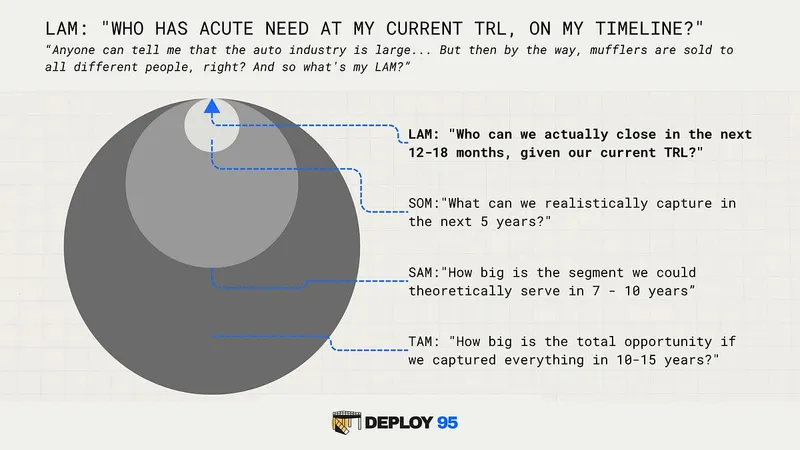 TRLと顧客生産サイクルの同
物理的な実体を伴う技術をPOC(概念実証)からレガシー産業へ移行させる際、「PoCの谷」と呼ばれる大きな壁に直面する。
この壁を乗り越えるには、技術成熟度レベル(TRL)、顧客の生産サイクル、資金繰りの三つのタイムラインを正確に同期させることが不可欠である。
創業者たちはTRLを過大評価しがちだが、誤った見積もりは資金を浪費し、開発を停滞させる原因となる。
解決策として、従来の市場規模分析(TAM/SAM)から脱却し、現在の制約条件から販売可能な顧客を特定する「LAM(Launch Addressable Market)」を適用することが重要となる。
ハードウェア技術をレガシー産業に導入する際、プロトタイプ段階(POC)から本格的な量産・商用化へ移行する「POCの谷」という壁が存在します。本記事では、この難関を乗り越えるための具体的な戦略と、陥りがちな落とし穴について解説します。
技術成熟度(TRL)の過大評価
多くの起業家は、自社の技術が市場投入に非常に近いと考えていますが、実際にはその認識が甘いケースが多いとのことです。例えば、動作する試作品がある状態を「レベル6」と見なしても、量産可能な製品(レベル8)に至る道のりは想像以上に長いといいます。
特にAIハードウェアなどの分野では、本格的な量産化までに3年から7年かかることが一般的であり、この技術成熟度(TRL)の誤算がプロジェクト全体のスケジュールを狂わせる要因となっています。第三者による客観的な評価を受けることが極めて重要です。
顧客側の生産サイクルとの同期
企業の導入プロセスは固定されたスケジュールで動いています。自社の開発スピードと、顧客企業が製品を製造・展開するサイクル(例:自動車Tier1サプライヤーの36〜60ヶ月)を正確に合わせることが求められます。
もし技術成熟度が高くても、それが顧客の生産計画の窓口に合致していなければ、採用される機会は失われてしまいます。短期的な収益を追い求めるあまり、自社の開発期間と合わない顧客を選ぶのは避けるべきだそうです。
資金調達と現実的な進捗管理
TRLに対する楽観的な見通しは、必要な資金量を過小評価させます。本格的な支払いが発生するまでの間には「ブリッジラウンド」といった追加の資金が必要となるケースが多いとのことです。
また、VC(ベンチャーキャピタル)が求める四半期ごとの進捗と、産業AIにおける実質的なマイルストーンはズレが生じやすいといいます。現実を直視し、正直な開発計画に基づいて資金調達を行うことが重要だと指摘されています。
まとめ
POCの谷を越えるには、技術成熟度、顧客の生産サイクル、そして資金繰りの3つのタイムラインを正確に一致させることが鍵となります。表面的な市場規模ではなく、自社の制約条件から逆算した現実的な戦略設計が求められています。
原文の冒頭を表示(英語・3段落のみ)
This is the final part of a six-part series on selling technology with a physical footprint into legacy industries. Part 1 introduced the POC Valley. Part 2 covered the qualification test before committing. Part 3 discussed navigating through. Part 4 examined the POC economics. Part 5 unpacked pricing architecture.I’ve spent five parts writing about what happens inside the valley. One question kept circling: What does it actually look like when a company crosses? To close the series, I talked to Eric Klein.Eric Klein spent twenty years shipping products at Apple, Bungie, Palm, Real Networks, Sun Microsystems, and Nokia before his engineers started coming to him to fund their companies. He helped co-found Lemnos, one of the few hardware-focused venture firms old enough to have watched companies go from bench prototype to production line. He now invests through his own early-stage venture fund and studio, Mucking with Gravity.To cross the POC Valley, three timelines must align: TRL timeline: How long until your technology is production-ready; Customer’s production timeline: When they need you to be integrated into their cycle; and Capital timeline: How long does your runway last until you see payment.When these timelines don’t align, you get stuck burning capital without forward progress, or chasing revenue that pulls you off course. Eric calls it the onion problem; each layer operates on its own schedule.“You’re trying to figure out through the POC what they need to see, and when, to keep either intermediate funding milestones going or to move it from a POC to LOI or an MOU or a full contract… And then overlaying that, what does the VC want to see to gate more money, in case the customer isn’t funding all of this development?”The following sections show where each timeline breaks and what it costs.Founders overestimate their TRL by 2–3 levels. A working prototype isn’t a repeatable product."A lot of founders feel like their proof of concept is much closer to market readiness than it is from a technology perspective. They're like, oh my gosh, I'm already a 6 and getting to 8 is no problem."They're usually at 3."The biggest misestimation is either that they believe their TRL is farther along than they are, or that their ability to go from one snowflake to ten reproducible units that do the same thing it's harder than it looks."A snowflake unit proves the technology, but doesn’t prove you can do it again somewhere else. AI hardware companies typically take 3–7 years to reach mass production. Pure SaaS gets there in 3–6 months.Source: NASA TRL scale; hardware timelines from Deploy 95 interviews (2025).When your TRL is wrong, the whole deal timeline is wrong. “Being honest and having third parties who are not friends and family really review where you are when you begin to cross the POC Valley is incredibly important.”Your customer’s production cycle is fixed. If your TRL timeline doesn’t fit their window, they move on. If your technology integrates into your customer’s production process, your deployment window is tied to their build cycle. Different industries run on different schedules: warehouse and 3PL (6-15 months), auto Tier 1 suppliers (36-60 months), aerospace (48-96 months), and defence (96+ months).Source: OEM development timelines from public reporting.“If the TRL level is 3 or 4 but it’s on an eighteen-month cycle, you’ve got to climb from TRL 3 to TRL 7 or 8 in eighteen months. But if what you showed them is a snowflake, you’re at a disconnect from the very beginning.”Founders chase the shorter cycle because they’re faster to revenue, and easier to show the VC progress. But if your TRL timeline is 36 months and the customer's cycle is 18, they'll move on before you're ready. The right customer is the one whose clock matches yours.TRL optimism leads to undercapitalization. You’ll need a bridge round before payment arrives, and you’ll raise it from a weak position.When TRL optimism carries into your fundraise (lower ask, shorter timeline), you end up needing a bridge before the product is ready. You’re raising again from a weak position, mid-valley, with nothing concrete to show.“I’m in a call this week with a team where they showed me their initial hardware budget, and I said, I think you’re off by a significant digit and probably six to 12 months.”VCs expect quarterly progress. In industrial AI, meaningful milestones arrive on the customer’s schedule. So founders chase NRE. It’s revenue, but it pulls engineering in multiple directions and your TRL stops advancing. You’re funded but stuck.“In that window the only revenue you’re probably going to see is the NRE revenue. And then even with a binding agreement, remember you’re not going to get paid until they ship their product and get paid.”Repeat hardware founders raise for a longer timeline and model burn honestly. They’ve already paid for the mistake of underestimating both.The three gaps compound. Miss one window and you’re stuck chasing short-term cash that pulls you further off course. Miss your TRL window and the customer won’t bring you into their production cycle. Miss their cycle and you’re waiting another 12–24 months for the next one. That gap is when founders make the wrong call: taking a shorter-cycle customer not because it fits, but because they need something to show the VC.The discipline that breaks the loop: intellectual honesty about where you actually are. But how do you operationalize that honesty? For Eric, it starts with throwing out the standard market sizing playbook.The standard market sizing exercise starts broad and narrows down: TAM to SAM to SOM. But that sequence is unconstrained by your current reality. It tells you the market exists. It doesn’t tell you which customers you can actually reach given your TRL, runway, and timeline to payment.LAM, launch addressable market, inverts the exercise. Instead of starting with the market and narrowing to your product, you start with your constraints and find the customers who fit.“Anyone can tell me that the auto industry is large. Well, it turns out I only sell, I make a product that makes mufflers better. All right, well then I know what my SAM is. But then by the way, mufflers are sold to all different people, right? And so what’s my LAM?”LAM isn’t market sizing. It’s a different question: given where I actually am, who can I sell to right now without getting stuck?Source: Eric Klein (Lemnos) interview, May 2026; customer scoring based on standard B2B qualification frameworks.LAM isn’t about thinking small. It’s about building from what’s real. Eric uses three filters. A customer has to pass all three to be worth pursuing. Customers with acute problems will tolerate the rough edges. They’ll accept the snowflake unit, the engineers living on-site, the iteration cycles. They’ll partner with you because they need the solution more than they need it to be perfect.“Who out of all these disparate groups has the most acute need for my product? Is this a top-three problem for them?”If it’s problem number seven on their list, they’ll wait for your competitor to reach TRL 8. You’ve spent months on a customer who was never going to convert.Two customers might score identically on problem severity. “Let’s say the automobile industry and the drone industry scored the same on frequency, severity, and value. The integration cycle for an automobile is six years, for a drone it’s 24 months. I might take the drone as my launchable market because I could get to revenue faster. But if it’s going to take me 48 months to get to TRL 8, I won’t be ready before the drone company needs me. So I should really target the auto industry.”Source: Eric Klein (Lemnos) interview, May 2026; TRL timelines validated against NASA and ISO 16290:2013.The math here is unforgiving. If your TRL timeline is 36-48 months, the 24-month customer will move on before you’re ready.Eric’s filter: if five customers want the same feature your product doesn’t have, that’s a signal; build it. If one customer wants something the other four wouldn’t pay for, that work has to fund itself. Otherwise, you’re spending core engineering resources on a dead-end branch."My biggest piece of advice, and it is very contrarian to what your VC will tell you, is that the first thing you have to learn in terms of sales is how to say no. You have to know when to fire a customer."“Say yes to the people closest aligned to your product feature set, closest aligned to your business terms, and whose land-and-expand has the greatest potential.”The framework is cleaner on paper than in practice. Here’s what it looked like for one company that applied it. Path Robotics builds autonomous welding cells using AI and computer vision. Their first deployment illustrates what it looks like when all three LAM filters pass.Eric visited Path’s first customer, a Cleveland muffler shop. The problem was acute: skilled welders stuck on repetitive work. The cycle matched Path’s timeline. And the customer wanted what Path was building. All three filters passed.“Path deployed a unit that they were still in active development on at that customer site and literally lived with the customer. Not only were they increasing the quality of the product and the output for the customer, but they were in real time learning and refining the product that they over time would offer to many other customers….Your principal engineers are often at a customer site along with the sales team. Everybody is there. That’s not true later on in the cycle.”Then something shifts.“The second time, you don’t have to live there for twelve months. And the third time, the third customer, you only live there five months. And then at some point you stop living there because the core product does what it’s supposed to do. ”“If there are changes for the customer, they’re already built into the contract. You have application engineers doing that work, or it’s delta work covered under professional services.”When application engineers handle what principal engineers used to, when customization becomes professional services rather than core development, you’ve crossed.The valley’s depth depends on how honestly you answer three questions.Where am I really on TRL? Not where you told investors. Not where you hope to be. Where you actually are, validated by someone who isn’t friends and family.Whose cycle can I actually match? Given your real TRL timeline, which customers will still need you when you’re ready? The shorter cycle isn’t always better if you can’t meet it.Do I have capital to survive until payment? Not until signature. Not until LOI. Until the customer ships their product and pays you. That number is almost always longer than founders model.“The intellectual honesty about both where you are technically and from the business and capital perspective, you have to marry those. And if one side’s being intellectually dishonest, it will catch the other one and trip them.”The founders who cross can hold both things at once: the vision that makes people believe in them, and the honest map of where they actually are.Hi! I’m Trista, a former founder, early GTM at UnitX, now a GTM strategist for technical founders deploying into legacy industries. This six-part series covered the full arc of the POC Valley.Part 1: Introducing the POC ValleyPart 2: Surviving the POC ValleyPart 3: Navigating the POC ValleyPart 4: The Economics of POCPart 5: Pricing the POC and BeyondPart 6: Crossing the POC valleyThis series grew out of 18 months of conversations with founders, operators, and enterprise leaders working at the intersection of hardware, automation, and manufacturing. It wouldn’t exist without the people who gave their time, shared what they learned, often candidly, sometimes painfully, and let me quote them. Special thanks to Eric Klein for anchoring this final part. The POC Valley series assumed you already had a customer willing to run a pilot. Series 2 goes upstream: how do you get there?If you’re building in this space, buying, or stuck somewhere in between—I’d love to hear from you. Connect with me on Linkedin.ShareTRL (Technology Readiness Level) — A 1-9 scale originally developed by NASA to measure how close a technology is to deployment. TRL 3-4 is lab validation; TRL 7-8 is production-ready. Most founders overestimate where they are.Snowflake unit — A system that works at one specific site, tuned by your engineers for that environment. It proves the technology functions but doesn’t prove you can replicate it elsewhere.NRE (Non-Recurring Engineering) — One-time engineering fees paid by customers for custom development work. It’s revenue, but it doesn’t scale and can pull your roadmap off course.LOI (Letter of Intent) — A non-binding document signaling a customer’s intent to move forward. It’s a milestone, not a commitment.MOU (Memorandum of Understanding) — Similar to an LOI; outlines terms both parties intend to agree to, but typically not legally binding.LAM (Launchable Addressable Market) — The subset of customers you can actually reach given your current TRL, runway, and timeline to payment. Unlike TAM/SAM/SOM, LAM starts from your constraints and filters outward.Tier 1 supplier — In automotive and other OEM industries, the companies that sell directly to the manufacturer (e.g., Continental selling to GM). If you’re a component maker, you often sell to Tier 1, not the OEM.POC Valley — The gap between a successful pilot and production deployment, where most hardware-AI companies get stuck. Introduced in Part 1 of this series.No posts
※ 著作権に配慮し、引用は冒頭3段落までです。続きは元記事をご覧ください。