多様な健康保険商品が生み出す新しい選択肢
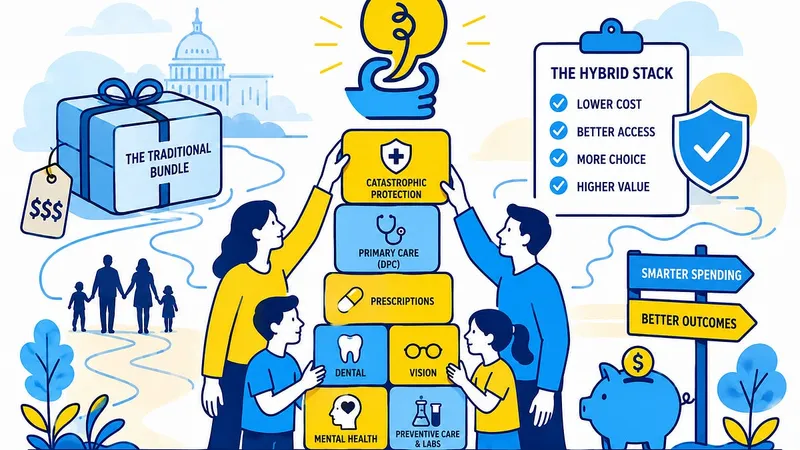 分解された医療の未来
米国の医療保険は、複雑で高額なパッケージとして提供されている。
実際には多くの製品から構成されており、各層に異なる経済が存在する。
患者の選択肢として、各層を個別に選ぶことが可能となりつつあり、新しい医療の形態が生まれている。
アメリカの医療制度は単一の製品ではなく、複数のサービスが組み合わさったものだ。2026年現在、医療費の支払い方法や税制が変化し、患者が選択肢を持つことが可能になった。
医療制度の構造と課題
アメリカの医療制度は、主に保険を通じて提供されるが、実際には予防医療、薬剤費、歯科、視力、精神保健など、複数のサービスが含まれている。これらのサービスは一つの名前で売られ、一つの価格で提供されるが、その背後には複雑な制度があり、患者のニーズと制度の経済的構造が衝突している。
直接型プライマリケアの登場
直接型プライマリケア(DPC)は、患者が月額の定額料金を支払い、医師と直接対応できるモデルだ。保険の介入を排除することで、医師の経費が削減され、患者と医師の関係性が改善されている。
税制改革と新たな選択肢
2026年1月1日から、DPCは税制上、医療費として認められることになった。家族は月額300ドルをHSA(健康貯蓄口座)で税金を払わず支払えるようになった。これにより、保険とDPCの組み合わせが可能となり、患者が選択肢を持つようになった。
まとめ
DPCの普及は、アメリカの医療制度の構造的な問題を解決する新たな道を開いた。患者が選択肢を持つことで、医療の質やコスト効率が向上する可能性がある。
原文の冒頭を表示(英語・3段落のみ)
A note before you read: This essay reflects my personal research and views, based entirely on publicly available sources. It is not connected to any client work or professional engagement, and it does not represent the views of any organization I am affiliated with. Nothing here should be read as a critique of any specific company or individual. The insurance system is complex, and the professionals who work within it operate within structures they did not design. This essay is about structural economics and emerging consumer alternatives, not about fault. It is intended as general information only and does not constitute medical, legal, tax, or financial advice. Verify current rules and consult appropriate professionals before making decisions that affect your family’s health coverage.Healthcare in America is not one product. It has never been one product. There are many products: primary care, catastrophic protection, prescriptions, dental, vision and mental health. All sold under one name, by one set of intermediaries, at one difficult-to-understand price. The bundle exists for reasons that made historical sense and that continue to serve certain purposes well. But it was assembled around institutional economics as much as patient need, and that tension has real consequences for the families paying for it.The families who have started to take the bundle apart are discovering something that has not been widely explained to them: that some of the pieces, on closer inspection, are not worth what they cost; that others can be had for far less; and that a few can be had for nothing at all.This essay is about what happens when you take the bundle apart, and why, in 2026, the conditions to do so have never been better.What follows is, on its surface, a practical guide. But underneath the numbers and the case studies, it is something else: an account of what ordinary people do when institutions stop serving them well. American healthcare did not fail suddenly or dramatically. It evolved in the way that many institutions fail, gradually and at the edges, in ways that were individually tolerable until, for many families, they were not. The families assembling alternatives are not revolutionaries. They are pragmatists, doing what people have always done when the system they relied on stops working: building something in its place. That quiet act of construction is worth understanding, both for what it saves and for what it reveals about the relationship between institutions and the people they were designed to serve.Consider, for a moment, the strange thing that happens when an American visits a primary care physician. The visit is fifteen minutes. The physician, who manages a panel of 2,500 or more patients, has perhaps glanced at the chart on the way into the room. The conversation is constrained by what insurance will reimburse and what the next patient’s appointment requires. The physician does not call back. There is a portal that routes messages through staff. The next visit is six weeks away.This is not the fault of the physician. It is the structural reality of a payment system in which insurance dictates what counts as a billable visit, how long it can last, and how much can be reimbursed. The result is that primary care, which is supposed to be the relational, longitudinal heart of medical practice, has become its most rushed and least personal layer. Most patients have come to accept this as the nature of the thing. It is not. Neither, it turns out, have all physicians.There is a different kind of arrangement, and it has been growing for two decades. It is called Direct Primary Care, and the model is straightforward. A patient pays a flat monthly fee, typically between $75 and $150 per adult, directly to a physician. The fee buys unlimited visits, longer appointments (thirty to sixty minutes is standard), direct access to the physician by phone, text, or email, and laboratory work at wholesale prices. There is no insurance involvement because insurance has been deliberately moved to where it makes sense in the equation.The economics work because the physician’s overhead collapses when insurance is removed. A typical primary care practice spends roughly forty cents of every dollar billed on the administrative apparatus of dealing with insurance: coders, billers, prior authorization specialists, and denial appeals. The DPC physician spends none of that. The result is that a panel of six to eight hundred patients paying directly generates more revenue per physician than a panel of twenty-five hundred patients billed through insurance and produces a fundamentally different experience of care for both patient and physician.According to Hint Health’s 2026 Direct Primary Care Trends Report, the most comprehensive industry analysis to date, there are now more than 2,700 DPC clinicians practicing across 49 states, serving more than 1.4 million members. DPC Frontier’s practice mapper lists more than 1,300 distinct practices nationwide. DPC membership expanded by 837% from 2017 to 2025, significantly outpacing U.S. population growth over the same period.What makes this development newly important is that, as of January 1, 2026, the federal tax code now treats Direct Primary Care as a qualified medical expense. A family can pay up to $300 a month in DPC fees from a Health Savings Account, tax-free, while simultaneously holding a high-deductible insurance plan that handles catastrophic events. Bronze and Catastrophic plans on the federal marketplace, the cheapest available, are now HSA-compatible. The combination, until recently a regulatory tangle, is now blessed by federal statute. This is the architecture of what we will call, throughout this essay, the hybrid stack.The way to understand the hybrid stack is to recognize that healthcare, despite being sold as a single product, is, in fact, a series of layers, each with its own economics. The mistake of the American insurance system, broadly speaking, is to charge a single premium for all of them and to extract its margin from the spread between what it pays for each and what it charges in aggregate. The opportunity for the family is to see the layers separately and to source each one from the seller best suited to provide it.There are seven such layers, and each behaves differently. Catastrophic protection, the first, is what insurance was originally designed for: the ER visit, the cancer diagnosis, the major surgery, the ICU admission, the prescription drug that costs ten thousand dollars a month. The economics of insurance work for these events because they are rare, expensive, and impossible to predict; the only sensible response is to pool risk across many people. This layer remains, and will remain, the province of real, contractually binding insurance.The second layer is primary care, which we have already addressed. The third is specialty and surgical care, where the picture is more situation-dependent. For a family with frequent, expensive specialty needs, comprehensive insurance is genuinely protective. For a family with predictable, occasional needs, cash-pay arrangements at transparent-pricing facilities can dramatically beat insurance-negotiated rates after the deductible. The Surgery Center of Oklahoma, in Oklahoma City, has become a national resource for the second category: it publishes its prices, and 40 percent of its patients now travel from out of state to use its services. A laparoscopic gallbladder removal is posted at $6,836, all in (per surgerycenterok.com, May 2026). A breast biopsy costs $1,900, according to a December 2025 profile in Medical Economics. The same procedures at a typical hospital can run three to ten times as much.The fourth layer is prescriptions, where the picture has shifted dramatically in the last few years. Mark Cuban’s Cost Plus Drugs, founded in 2022 as a public benefit corporation, now lists more than 2,000 medications at acquisition cost plus a 15 percent markup and a $5 pharmacy fee. Amazon’s RxPass, for $5 a month with a Prime membership, covers eligible medications on the RxPass formulary, currently including more than 50 common generics. GoodRx compares cash prices across tens of thousands of pharmacies and often finds prices below the insurance copay. For most common chronic-disease medications, including those for hypertension, hypothyroidism, type 2 diabetes, and depression, the cheapest source is now outside insurance entirely, and the savings can be substantial even for the well-insured.The fifth and sixth layers, dental and vision, are perhaps the clearest cases where insurance has outlived its purpose. Annual dental benefit caps of one to two thousand dollars mean that a single root canal can hit the limit. Practice membership plans, in which a family pays the dentist directly for cleanings, X-rays, and discounts on additional work, typically run $30 to $40 per adult per month and beat traditional dental insurance for most families. Vision is similar: Costco Optical, Warby Parker, and online retailers have made eyewear genuinely cheap, and a routine eye exam, paid for out of pocket, is usually less than $150. The arithmetic of dental and vision insurance no longer holds up for most people.The seventh layer, mental health, is the weakest of all under the traditional insurance model. Networks are narrow. Wait times are long. Many of the best therapists do not take insurance at all. Direct-pay therapy, sliding-scale platforms like Open Path Collective, and the willingness of DPC physicians to handle the medication-management portion of routine mental health care have, for many families, produced better access and better outcomes than what insurance can deliver.For most families, that combination begins with a high-deductible Bronze plan for the catastrophic layer, adds a Direct Primary Care membership for the primary layer, uses cash-pay arrangements for predictable specialty care, sources prescriptions entirely outside insurance, and replaces dental and vision insurance with direct relationships. The savings for a typical middle-income family can run from $5,000 to $20,000 a year, depending on state, age, and health status. The quality of day-to-day care, by most measures studied, improves.A caveat is in order here, and it is not a small one. In the American healthcare landscape, there exists a category of arrangement that markets itself as an alternative to insurance, costs less than insurance, and is not insurance: the health-sharing ministry. The names are familiar to anyone who has listened to Christian radio or browsed alternative-medicine websites: MediShare, Christian Healthcare Ministries, Samaritan, Sedera, Liberty HealthShare. Their marketing is polished, their rhetoric carefully appealing, and their defining structural feature is this: they have no contractual obligation to pay any member’s medical bills.The membership documents say so, in language reviewed by lawyers. Approximately 30 states have passed safe-harbor laws that exempt these arrangements from insurance regulation entirely. Federal law treats them as exempt from the Affordable Care Act’s requirements. They are voluntary cost-sharing arrangements, a phrase that should be read with the emphasis on voluntary.The risk is not theoretical. Sharity Ministries, formerly Trinity HealthShare, administered by Aliera Healthcare, filed for bankruptcy in 2021. Court documents filed during the liquidation process showed over $300 million in unpaid member claims. State regulators warned members that recovery would likely be a fraction of the total, according to statements from the New Hampshire Insurance Department.Liberty HealthShare, the subject of a 2023 ProPublica investigation, was found to have used $140 million of $300 million in member fees over a seven-year period to fund businesses affiliated with its leadership, including a boutique airline, a marijuana farm, real estate, and carpet stores, while members’ bills went unpaid. Medical Cost Sharing Inc., whose assets were seized by the Justice Department in the same year, had collected $8 million in revenue and used approximately 3 percent of it to pay medical claims, according to DOJ prosecutors.The state of Colorado alone among American states requires health sharing ministries to publicly disclose their financial data. The most recent disclosure, for 2023, found that of the $96 million in member medical costs submitted, only $34 million was actually paid. The rest was either deemed ineligible under various exclusions or simply not paid. This was Colorado, the regulated state. The unregulated states have no comparable data, and what we know suggests that what we do not know is worse.The savings are bounded. The downside is unbounded.Health sharing ministries are excluded from the framework presented in this essay, and the exclusion is principled. The savings, compared to insurance, are real but bounded: five to ten thousand dollars a year for a family. The downside is unbounded. An $80,000 surgery was denied as a pre-existing condition. A $200,000 cancer treatment was denied because the diagnosis came within an exclusion window. A ministry that simply collapses, leaving the member with no recourse and no contract to enforce. Insurance is contractually required to pay covered claims; health sharing is not. Direct Primary Care memberships are contractually required to deliver the services paid for. Cash-pay arrangements are contracts per transaction. Health sharing arrangements, by their own legal documents, are not contracts at all.The marketing is most aggressive toward the families who can least afford a catastrophic denial. For families in financially fragile positions, for families with chronic conditions, for families considering this arrangement during pregnancy, the asymmetric risk is exactly the wrong shape. That is not a coincidence. Everything that follows in this essay relies on contractually binding cost models. Families should insist on the same.Two regulatory developments shape the landscape families now face, pulling in opposite directions. The first, which took effect on January 1, 2026, made traditional comprehensive insurance significantly more expensive for many families. The second made the hybrid stack significantly cheaper. Together, they have created a moment in which the rational answer to the cost of American healthcare is, for many families, no longer the answer most Americans currently give.The first development is the return of the subsidy cliff. From 2021 through 2025, under the American Rescue Plan and the Inflation Reduction Act, the Affordable Care Act’s premium tax credits were temporarily expanded to cap household premium contributions at 8.5 percent of income for everyone. Those enhanced subsidies expired on December 31, 2025. The original ACA rules, which limit subsidies to families earning below 400 percent of the federal poverty level, were reinstated. The 400 percent threshold in 2026 is approximately $62,600 for a single person, $84,600 for a two-person household, and $128,600 for a family of four (figures differ in Alaska and Hawaii). Earning a single dollar above the threshold strips all subsidies, not just a portion. The cliff is binary and brutal.The result, for families above the threshold, is sticker shock. A sixty-year-old couple who paid a few hundred dollars a month under the enhanced subsidies in 2025 now pays $2,000 a month for the same plan in 2026. The friend whose situation prompted this essay, a middle-aged man considering early retirement, was quoted $1,700 a month for marketplace insurance for himself and his wife. He had not retired in haste. He had calculated, carefully, what his savings could support. The healthcare line item changed the calculation.The second development, which took effect the same day, is the One Big Beautiful Bill Act. The law, signed on July 4, 2025, made three structural changes that, taken together, amount to federal validation of the hybrid stack. Bronze and Catastrophic ACA plans, the cheapest available, are now Health Savings Account compatible regardless of their deductibles. Direct Primary Care memberships no longer disqualify HSA contributions, up to $150 per month for individuals and $300 per month for families. And HSA dollars can now pay DPC fees tax-free, within the same limits.The combination is more important than either piece alone. A family can now hold a low-premium catastrophic insurance plan, fund a Health Savings Account up to $8,750 a year (plus a $1,000 catch-up if either spouse is fifty-five or older), pay their Direct Primary Care fees from that account, and use the remainder for their out-of-pocket medical expenses. The entire arrangement is constructed from contractually binding pieces and tax-advantaged at every step. The federal government has, almost without anyone noticing, blessed an architecture that existed at the margins of the healthcare system for two decades. The architecture is now ordinary tax law.This convergence (the cliff and the validation) arrives at a moment when the underlying infrastructure has matured. The Direct Primary Care movement has crossed the threshold from niche to general availability. Cash-pay surgical centers exist in most regions of the country. Cost Plus Drugs and Amazon RxPass have made cash-pay prescriptions a viable strategy for the first time in decades. A family making this transition in 2020 would have had to assemble the pieces from scratch and might not have found them. A family making this transition in 2026 has a fully developed alternative ecosystem to draw on. The system has not been fixed. But the workaround has matured, the pieces are in place, and the cases that follow show what it looks like when a family builds it.A common objection to the hybrid stack is that it cannot work for families with chronic conditions, and this objection deserves to be taken seriously and, with some care, refined. The objection is correct in a narrow sense and wrong in a broader one, and the distinction matters for a great many American families.The chronic conditions for which the hybrid stack does not work well are a small and specific set: active cancer treatment, end-stage renal disease requiring dialysis, conditions requiring infused medications that cost $10,000 a month or more, transplant patients on lifelong immunosuppressants, advanced heart failure requiring frequent specialist intervention, and active inflammatory bowel disease requiring biologics. These are conditions in which the family is hitting the deductible and out-of-pocket maximum every year, and in which the predictable cost-sharing of comprehensive insurance is genuinely worth more than the higher premium.But the great majority of what is called chronic disease in America is not in this category. Type 2 diabetes managed with metformin, the first-line drug, costs about $4 a month from Cost Plus. Hypertension on a generic ACE inhibitor or ARB costs pennies. Hypothyroidism on generic levothyroxine costs $5 to $15 a month. Most autoimmune conditions on stable maintenance therapy, most well-managed asthma, most cases of GERD, depression, anxiety, fibromyalgia, and migraine are routinely managed with generic medications that cost almost nothing, and benefit dramatically from the time-rich, relational care that DPC provides and that fee-for-service insurance, with its fifteen-minute appointments, structurally cannot.Multiple sclerosis is a useful example because it sits in the middle. The medications for MS can be expensive, but for many patients with stable disease, the relevant care consists of an annual or semiannual visit with a neurologist who knows the patient’s history, periodic MRI scans to monitor disease activity, and management of any associated symptoms. The neurologist relationship, for a family with the means, can be a concierge arrangement at a cost of $125 to $200 a month, which deli
※ 著作権に配慮し、引用は冒頭3段落までです。続きは元記事をご覧ください。
Hacker News コメント
機械翻訳。HN の元スレッド ↗
一つの製品、多くの部品
原文
Actual title is "One Product, Many Pieces", but I changed it to appeal to the technical and engineering audience here.